
.|

NEWS
A variety of immigration, business and general news articles taken from New Zealand newspapers, websites and other sources (sources are mentioned at the bottom of each article) and selected by Terra Nova Consultancy Ltd. It may assist the reader being more or less up-to-date what is happening in Aotearoa, "the Land of the Long White Cloud". Happy reading, enjoy ... and if you have any questions on these updates - please contact us...
Newest article always on top.
11/12/19 - The number of work visas being approved is rising strongly while residency visas are falling
New Zealand's total migrant population increase was a whisker short of 17,000 in the 12 months to the end of November.
The latest figures from the Ministry of Business Innovation and Employment (based on Immigration NZ data) show there were 472,800 people in this country on migrant visas at the end of November, up by 16,989 (+3.7%) compared to the same time last year.
NZ's migrant population has been steadily increasing for the last six years (see graph below), rising from 343,065 at the end of November 2013 to 472,800 at the end of last month, an increase of 129,735 (+37.8%) over that period.
Of the 472,800 migrants at the end of November, the biggest group by far were the 211,698 people on work visas, making up 45% of all migrants, followed by 185,463 on residence visas (39%) and 74,109 on student visas (16%).
Not only are people on work visas the biggest group of migrants in the country, they are also the fastest growing group.
In the 12 months to the end of November 251,133 work visas were approved, up 9.3% on the previous 12 months and up 53.5% on the 12 months to November 2013.
By comparison just 34,614 residence decisions were approved in the 12 months to November, down 12.6% on the previous 12 months and down 31% from the recent peak of 50,139 residency approvals in the 12 months to November 2016.
(Source; Interest, Greg Ninness)
05/12/19 - Immigration quota talks begin as 35,000 wait on residency decision
The government coalition parties have started talks on how many new residents they will allow into the country.
Residence approvals are at the lowest levels since the turn of the century.
Immigration is shaping up to be a major election issue next year, with New Zealand First saying it will continue its push to curb immigration.
And that year will start with the potentially thorny issue of setting the number of residence visas the government
will grant.
The number of approvals by the end of this year - when the current residence programme target expires - is expected to be at the lower end of the government-set 50,000 to 60,000 planning range.
Residence approvals are at the lowest levels since the turn of the century.
More than 35,000 people are waiting for a residence decision, the highest number since 2011.
Many had been waiting for more than a year and without residence could not buy a home under the foreign buyers' rules, immigration adviser David Cooper said.
"And there's no sign that that queue's about to get sorted, because the government hasn't announced what its decision is for the residence programme for 2020 and beyond," he said.
"That impacts on employers, who are being faced by panel beaters, qualified carpenters, builders etc. who are fronting up to employers saying 'It's a year on - I can't get a mortgage, I can't borrow money from the bank, and I'm not about to get residence any time soon, how are you going to help me?'
"Because if you can't, I'll go to Australia or Canada where I don't even need a job to get into those countries.
There's a lot of pressure that's coming on the system and the employers and the skilled migrants in particular.
Government options
The government had three options, he added, and the first was to keep numbers the same.
"If they do that, and assuming it's on an 18-month period, that quota for skilled migrants will be just about full by whoever's in the queue [now]," he said.
"If they keep the status quo that just means the queues are going to keep growing. In 18 months' time we'll have something like about 30,000 applications in the queue, which will be about 65,000 people - and there's only places for about 30,000. So, do the math, you can see it's a train wreck waiting to happen."
If they were to take option two of reducing numbers or suspending categories, that would send the wrong messages to immigrants and employers.
Option three was no easier, he said, as increasing the numbers may be politically unpalatable.
"Maybe they'll make a decision and tell everybody just before we all go on holiday, so that it gets lost in the ether, but we need to know and the market needs to know because there's a lot of employers out there that are having to deal with difficult situations."
A spokesperson for the immigration minister, Iain Lees- Galloway, said discussions between coalition partners were underway and a decision should be announced later this month or in January.
(Source: RNZ, Gill Bonnett)
27/11/19 - Immigration NZ accused of 'extreme vetting' to limit numbers
Immigration representatives say bureaucratic tactics are being used to slow down residence processing.
The immigration industry says officials are using what one lawyer described as Donald Trump-style "extreme vetting" to limit immigration numbers.
Immigration representatives say bureaucratic tactics are being used to slow down residence processing, a claim Immigration New Zealand (INZ) denies.
New residents fell to the lowest levels since the turn of the century this year despite a sharp increase in applications.
The number of residence applications rose from a low of 15,000 in April last year to 35,000 last month, according to figures from the INZ website.
The body that represents immigration lawyers and advisers, the Association for Migration and Investment, said it was concerned at the visa process slowdown and whether there were ulterior motives for it.
"When a case officer can come back and ask for any additional information, you'd think they'd come back and ask for all the things extra they need," its chairwoman June Ranson said.
"The problem is, you give them that, and then it's almost as if they invent another question. Rather than wrapping it all in together, they go backwards and forwards - it's almost like you've got a new penpal, and they want to keep in touch with you.
"That is totally inefficient, but it is happening, and it just drags out the application so you wonder if there's ulterior motives to it."
Immigration lawyer Richard Small said there was a growing culture of "extreme vetting" alongside a decrease in discretion in decision-making.
American President Donald Trump took office promising to enact an "extreme vetting" immigration system.
American academics say having been blocked on building a wall with Mexico to limit immigration numbers, the Trump administration was using the "invisible walls" of long processing times and administrative changes to make it harder for immigrants to work, settle and visit family there.
Case officers in New Zealand were asking for information they did not usually request and which were sometimes not contained in immigration instructions, said immigration adviser Toni Alexander.
"I had to remind an officer over and over that a medical was cleared, for instance, now when there should be no further obstacles, she has decided to submit a request for an NZ police clearance, a request which should have been made a very long time ago. A police clearance can take six weeks - so it is just a delaying tactic.
Donald Trump took office in the United States promising to enact an "extreme vetting" immigration system.
"We're frequently told [by case officers] 'oh well, my technical adviser told me to ask for this'. So they're being instructed from above and it's a process of slowing down applications because technical advisers are senior people, and they know the instructions very well, as well as we do."
Immigrants had been waiting so long that even their extended temporary visas were now expiring, she said, adding expense and inconvenience.
They were being asked to resubmit evidence that had become outdated because of the delays.
INZ border and visa operations general manager Nicola Hogg said in a statement there had been no attempt to slow visa processing.
"New Zealand continues to be an attractive destination and application volumes have been increasing steadily across all categories," she said.
"We are also seeing an increase in the level of risk and complexity in applications.
"Certain applications are always going to take longer to process because of the risk factors present."
There were two main stages when applicants were asked for additional information: when the application was first received and after it was allocated to a case officer.
"However, sometimes when we receive information, we need to make an additional request for further information - for example, if the information supplied is insufficient to demonstrate immigration requirements are met," she added.
(Source: NZ Herald - RNZ, Gill Bonnett)
06/11/19 - Govt asks immigration changes be reversed back to status quo
The government has asked Immigration New Zealand to reverse its tougher stance on partnership visas that was having a particular impact on the Indian community, says the Prime Minister.
A change in approach by immigration officials to partnership visas - insisting that couples have to spend time living together in order to be eligible - means Indians in particular are having a much harder time bringing their spouses to New Zealand.
After people spoke out about the tougher stance on both the parental category visa and partnership visa, the senior NZ First MP Shane Jones last month lashed out at the Indian community, telling them to "catch the next flight home" if they didn't like the country's immigration policy.
While NZ First leader Winston Peters continues to claim credit for the changes, Minister of Immigration Iain Lees- Galloway insists no government directive was given.
Prime Minister Jacinda Ardern says Immigration New Zealand "carte blanche of their own backs made changes - our expectation is that we return to the way we were operating prior to the changes that were made''.
She said it wasn't a decision made by any minister - in direct contrast to Mr Peters' claims New Zealand First influenced the decision and Immigration New Zealand, saying the change was made in line with government policy.
"That was changed as a result of Immigration New Zealand officials changing the way they're operating. They did not do that under the authority of Cabinet, my expectation is that we will reverse back to the status quo and the way it was operating before,'' Ms Ardern said.
"That decision never came to Cabinet it was a decision made arbitrairily by officials, and we're seeking for that to return to the status quo,'' she said.
Last month Mr Peters was happy to take the credit for a tougher approach to partnership visas.
"Has New Zealand First had an influence on trying to tidy up the quality of information on which the immigration department relies? The answer is profoundly yes," he said.
It was simple, he said, you're either a partner under New Zealand law, or you're not.
"It's clear as daylight - they're not partners - full stop", he said.
Mr Jones was unaware of the Prime Minister's expectation that the policy be reversed to the status quo.
Speaking to reporters immediately after Ms Ardern made the comments, Mr Jones said New Zealand First being signed up to a coalition agreement with Labour did not stop him "as a retail politician belonging to a nine person caucus continuing to evolve our thinking in relation to immigration''.
(Source: Radio New Zealand, Jo Moir )
31/10/19 - Your possible options for Residence under SMC may now have increased ….
Your possible options for Residence under SMC may now have increased ….
31/10/19 - Almost 35,000 residence visas and 246,705 work visas approved in year to September
The number of residence visas being approved hit a 10 year low in the 12 months to September while the number of work visas hit a 10 year high.
Figures compiled by the Ministry of Business Innovation and Employment (Immigration NZ is part of MBIE) show that 34,992 residence visas were approved in the 12 months ended September this year, the lowest number for that period since MBIE began compiling the figures in 2009.
The figures show that 45,057 residence visas were approved in the 12 months to September 2010 and the numbers then declined steadily over the following three years before rising sharply to hit a peak of 51,723 in 2016, before falling away again over the following three years (see graph below).
That means the 34,992 approvals in the year to September were down 10,065 (-22.3%) compared to the same period of 2010 and down by 16,731 (-32.3%) compared to the 2016 peak.
The largest number of residence approvals by nationality were people from India at 4776, followed closely by China 4767, South Africa 3957,the UK 3378, Philippines 3039, Samoa 2145, the USA 1263 and Fiji 1083 (all 12 months to September).
However, while the number of residence visas being approved has been steadily declining, the number of work visas has been steadily rising and hit a 10 year high of 246,705 in the 12 months to September, which was up 80,187 (+48.2%) compared to the same period of 2010 (see graph below).
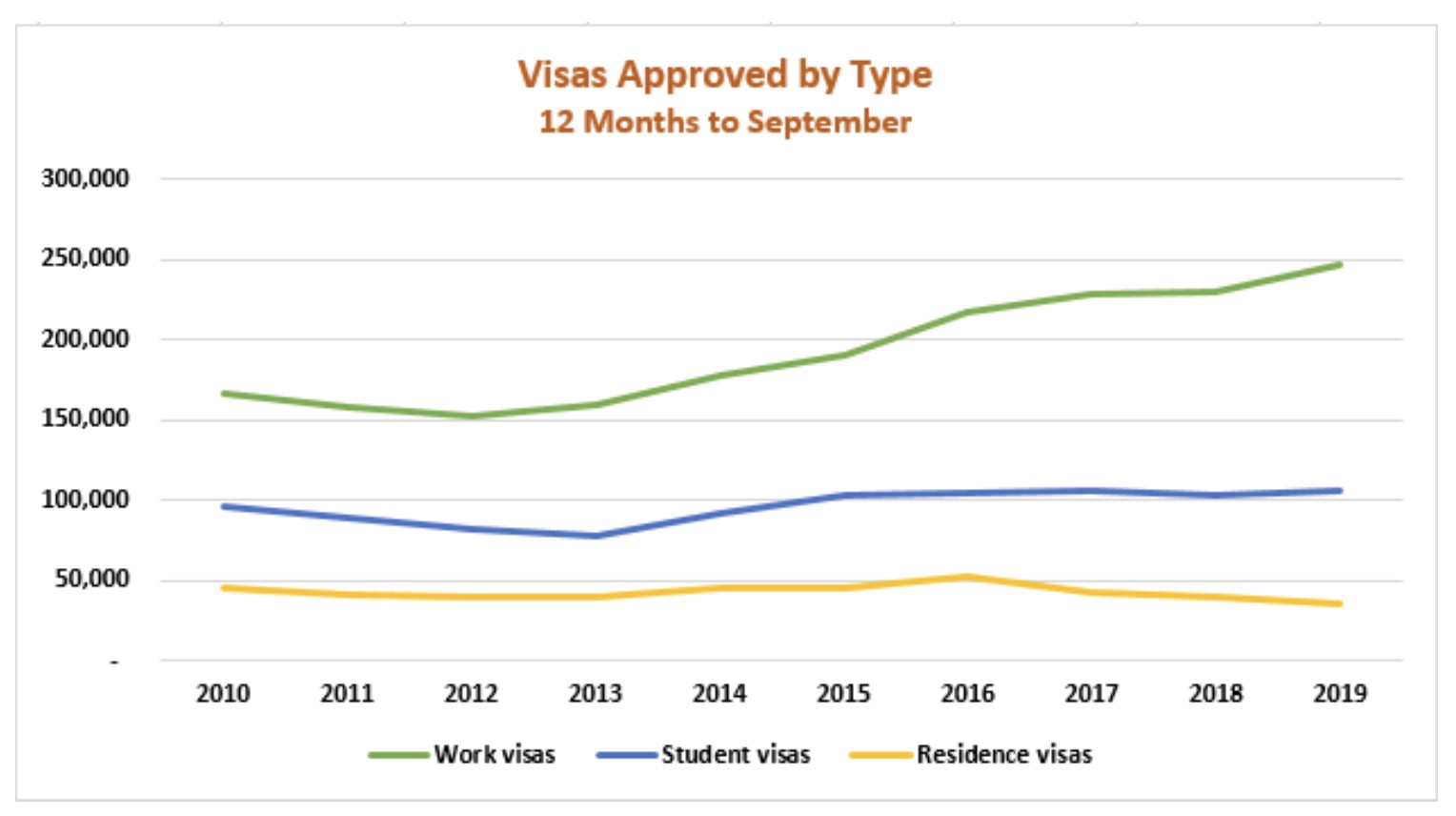
While residence and work visa approvals have shown strong trends up or down, student visa approvals have
remained largely consistent at around 100,000 a year for the last 10 years.
In the 12 months to September this year 105,450 student visas were approved, just below the 10 year peak of 106,197 approved in same period of 2017.
(Source MBIE)
27/10/19 - An open letter to Jacinda Ardern from small and medium business owners
Dear Jacinda,
As an insolvency-specialist lawyer, I see a high volume of business owners who are really struggling and many who ultimately fail and lose everything.
These hardworking New Zealanders often do everything for their businesses.
They are their own product/service developer, finance department, marketing department and sales department.
There is often no "work-life balance", we now talk about "work-life integration".
What I'm getting it is, being in business is hard.
But you may not appreciate that.
Because if you did have a basic understanding of SME (small-to-medium enterprise) life, there is no way that you would be acting the way that you are. There is no way that your Government would have the policies that you do.
For example, you are making it difficult for New Zealand SMEs to employ foreigners for roles Kiwis don't want anyway. You are increasing employee costs for business owners who aren't even paying themselves a living wage.
You are making it harder for employment relationships with changes to the trial period provisions. You are increasing costs to business by tampering with fuel costs. There is uncertainty over the tax position of SMEs and how that could play out.
For many businesses the future is uncertain.
I've worked with hundreds of businesses that have failed and have encountered hundreds of different reasons for that failure.
Cranes over the Auckland skyline hint at continuing economic growth, but there are many challenges for SMEs.
There are a variety of reasons, maybe there was insufficient capital to survive. Maybe large contracts did not eventuate or were lost.
Maybe the business did not keep up with innovation. Perhaps contracts were not priced properly. Perhaps there were unexpected expenses.
Perhaps the business was not managed properly.
Maybe the Inland Revenue was not paid in a timely manner or the payment of tax wasn't managed properly which created a large liability that was incapable of being paid.
Perhaps the business partners' relationship imploded, and the business subsequently did too.
According to figures from the Ministry of Business, Innovation and Employment, 63 per cent of companies started in 2010 were gone by 2016.
The reliability of this statistic is problematic but represents a massive problem.
The Government is now investing significant resources to regulate the insolvency industry due to the volume of corporate failures which has attracted all sorts of cowboys.
Many SME directors in New Zealand tie their identity to their company. The way they trade reflects this.
A common misconception is that directors of companies have limited liability.
Directors will often do everything they can to prop up the business. If they had a trust with assets, it is very common to see them pulling the assets out to pay the debts and attempt to keep the business afloat.
Most lose everything in this attempt.
If they don't do this, they are likely to have given personal guarantees all around town and if the holders of those guarantees don't tip them up, a liquidator may sue them for everything under the sun and they end up broke.
Undoubtedly, financial problems put a massive strain on relationships so therefore it's very common to see marriages ending at the point of insolvency and families getting split.
Business owners have an extremely stressful role. They literally risk everything. Their assets, their time, their physical health and their mental health. They do it because we are great optimists in New Zealand. They do it for the nest egg. The better future for them and their loved ones.
And if they are successful, they will contribute in a very important way to our economy and they will provide employment to many New Zealanders who don't want to or can't run a business.
So, why do you and your party wish to make life even more difficult for hard working Kiwi business owners?
It is about time that priorities were re-evaluated. We need policies that support SMEs, not put more burden on them.
It is about time that you got a real grasp on your impact on SME businesses in New Zealand. Because you need them. We need them. Everyone needs them to not only survive, but to thrive.
Source; Brent Norling, Director of Norling Law Barristers & Solicitors
25/10/19 - Construction industry at the top of the ladder for growth
The construction industry added 12,820 more enterprises and 45,400 more employees over the five-year period to February 2019 – the highest gains by any of the 19 industries, Stats NZ said today.
These increases reflect an average annual growth rate of 4.5 percent for enterprises and 6.1 percent for employees for this industry over the past five years. This is more than double the corresponding growth rates (2.0 and 2.7 percent, respectively) for all industries combined for the same period.
“In the year to February 2019, the construction industry added 3.9 percent more employees – the second-highest increase among all industries, both in number and percentage,” business register manager Mary Reid said.
Strong growth in residential building construction
At February 2019, there were 65,320 enterprises in the construction industry overall, engaging 177,000 employees. Of these, 21,650 enterprises were in the residential building construction industry sub-group, employing 30,300 people.
“Residential building construction had 52.4 percent more employees than five years ago, reflecting an average annual growth rate of 8.8 percent over the five-year period to February 2019,” Ms Reid said.
The number of new residential buildings consented during the past five years (to August 2019) had a similar growth pattern, with the number of consents rising at an average annual rate of 8.2 percent.
The non-residential building construction sub-group, which mainly covers commercial and industrial buildings, had 13,300 employees engaged at February 2019. This follows an average annual growth rate of 5.1 percent over the past five years.
Explore the average growth for geographic units and employees during the last five years by more detailed geographic areas in our interactive map.
Source: © Scoop Media, Press Release: Statistics New Zealand
14/10/19 - Visa scam: Tourists to NZ fleeced over new online applications
Tourists are being fleeced by seeking new visas through third parties, Immigration NZ warns.
National is blaming the Government's "clumsy implementation" of its tourist tax for unofficial foreign websites popping up and fleecing would-be visitors to New Zealand.
This comes as Immigration New Zealand is urging tourists to this country to use official apps or websites to apply for the new online visa and international visitor levy.
The warning comes as non-official sites have been found to be charging travellers up to 10 times the normal $35
for the International Visitor Conservation and Tourism Levy and the $9-$12 price for the NZ Electronic Travel Authority (NZeTA).
The levy came into effect on July 1 requiring many tourists, working holiday visitors, some workers and students to pay $35 each to help fund tourism infrastructure and conservation projects.
The NZeTA also became mandatory for visitors from 60 visa waiver countries on October 1. It must be applied for before a visitor enters New Zealand and costs $9 on INZ's mobile app or $12 on its website.
National's Tourism spokesman Todd McClay said people were turning to the unofficial apps and websites because the official ones were too difficult to use.
"Kelvin Davis [Minister of Tourism] promised to make it easier for people to visit NZ, but his rushed implementation of tourist tax has instead led to unofficial websites and a clunky app," McClay said.
"The Government has released an official app, but each visitor has to use it separately so families cannot pay the tax in one simple transaction. It's bureaucratic and a hassle for travellers."
McClay said MBIE was correcting up to a thousand applications each week because of the app's poor reading of passport numbers and names.
"The Government was warned its new tax would mean fewer visitors and a loss of up to $70 million for small businesses...we're already seeing the consequences...with falling numbers from major markets like India and China," McClay said.
INZ said a growing number of companies that had no connection with INZ or the NZ Government are operating under potentially misleading names such as "official- newzealand-eta.org" and "newzealand-eta.gov.org" were charging visitors up to 10 times the official price.
Stephen Dunstan, INZ general manager, said: "We are seeing a growing number of third parties charging visitors for something they can very quickly and easily do themselves and that is concerning."
Dunstan said the application took just a matter of minutes to complete on the agency's official sites.
"Some third parties are also claiming to be able to provide an expedited service. However, an expedited service is not available and third parties are only able to submit the traveller's information to INZ using the same web form or mobile app travellers can use themselves," he said.
"In some cases, these third parties are also collecting additional information from travellers, which isn't actually required as part of the NZeTA request."
The agency, Dunstan said, was working hard to ensure travellers knew to use the official government website through its global marketing campaign.
"Our global digital marketing campaign, which links directly to the INZ website, is helping to ensure travellers use the official channels to request their NZeTA.
"We're also working closely with airlines, travel agents and cruise operators to make sure they're directing travellers to the official government website or mobile app."
Source: NZ Herald, lincoln TAN)
17/09/19 - NZ's border to be tightened
Kiwis urged to ‘spread the wordʼ to avoid disruption as new visitor travel requirement kicks in.
Ordinary New Zealanders are being asked to play a part in helping smooth the way for a new measure aimed at keeping out overseas visitors who pose a risk to our security.
From October 1 the 1.5 million people who visit from 60 "visa waiver" countries every year will be required to obtain a New Zealand electronic travel authority - an NZeTA - before being allowed to board a plane or cruise ship bound for New Zealand.
The move is designed to prevent people travelling here who are considered a risk to New Zealand's safety by identifying them well before check-in.
Authorities are looking to identify anyone previously sentenced to a term of imprisonment of 12 months or longer, those considered a threat to national security or who are members of a terrorist group. Travellers coming by air or cruise ship will be required to answer questions about any criminal convictions and the purpose of their trip.
Immigration New Zealand (INZ), which has been working closely with the travel industry to alert international visitors to the change, is also calling on those Kiwis expecting overseas visitors to help spread the word about the new rules.
INZ's Director of Policy Integration Nick Aldous says it is important those planning to come to New Zealand, particularly over the coming summer season, are aware of the need to request an NZeTA.
"This is a key travel time for many tourists, especially those coming to visit friends and relatives over Christmas," he says. "Those affected will be denied boarding if they do not hold an NZeTA so, if you've got people coming, it's important to spread the word about these new rules to ensure they get on board and their travel isn't disrupted."
Visa waiver countries, those whose citizens do not need a visa to come to New Zealand, include the UK, the United States, Canada, Hong Kong, Malaysia and most European countries.
Anyone denied an NZeTA can apply for a visitor visa, a process which will allow a more in-depth look at individual circumstances.
Currently visitors flying to New Zealand only receive light-touch screening at check-in, while cruise ship passengers and crew are not screened at all. But the NZeTA will give authorities early warning of individuals who potentially pose a risk Aldous says.
"In the past we have often not been aware of this until they arrive or after a plane is in the air. Now we can manage the situation earlier and avoid making decisions (on these people) on the fly."
Aldous believes the measure will reduce the number of those who are denied entry on arrival (last year 1173 were turned away at the border) because authorities will be alerted to suspect travellers earlier.
The new requirement excludes New Zealand and Australian citizens and those who already hold a valid visa for New Zealand. An NZeTA, once approved, will be valid for two years and visitors will be able to come and go as often as they wish within that period. However once expired, travellers will need to reapply.
Aldous says the introduction of the NZeTA not only aims to keep New Zealand safe and strengthen its borders, it also brings the country in line with "best practice" systems introduced in other countries. Among those with similar rules are the US (ESTA), Canada (eTA) and Australia (ETA), while the European Commission is introducing its own in 2021 (ETIAS).
While it is a traveller's responsibility to check their travel and entry requirements, Aldous says "we appreciate it's a significant change for visitors and based on the experience of other countries there will be a transition period before it becomes a natural process."
An NZeTA can only be requested electronically either by downloading a free NZeTA app or by completing an online form (at immigration.govt.nz/nzeta).
Requests will cost $NZ9 (via the app) or $NZ12 (through the website).
Aldous says it could take up to 72 hours to process and for this reason he advises people to request their NZeTA well in advance of travel. No hard copies are needed, however if people forget to make a request or they are unaware of the need to apply, they can still go online at the airport and, in most cases, should receive approval in time.
Aldous says on average 22 per cent of travellers from visa waiver countries come to New Zealand to visit friends and relatives. The percentage is even higher for those from the UK (46 per cent), Canada (29 per cent) and Hong Kong (25 per cent).
"Given this, it is important for Kiwis to be informed and aware of the changes," he says.
At the same time Aldous says the ministry has been talking with airlines, cruise lines and tourism industry bodies to ensure the travel sector has the support and knowledge required to implement the NZeTA in a way that minimises the impact on travellers.
For more information on the NZeTA, visit immigration.govt.nz/nzeta
(Source; NZ Herald)
03/09/19 - Desperation over partnership visa delays
Visa applicants protest outside Immigration NZʼs Mumbai office, and Kiwis head back to India, as lengthy processing delays put strain on relationships, finances and mental health. Laura Walters reports.
New Zealand residents and their partners are suffering mental health issues and some are returning to India due to lengthy delays in partnership visa processing.
High application volumes, coupled with the closure of offshore processing offices, have led to a massive backlog in the processing of partnership visa applications, particularly those coming from India.
Newsroom has received correspondence and stories from hundreds of applicants who have been trying to get partnership visas over the past year.
Many of the applications have not been assigned to case officers months on, with some waiting more than five months.
Applicants who followed up with Immigration NZ were told average wait times were between five and seven months for non-urgent applications.
Immigration Minister Iain Lees-Galloway has repeatedly expressed his displeasure at the delays.
Meanwhile, Immigration NZ has changed its systems, and added staff, in an effort to improve processing times.
From this week, all new partnership visa applications from India, Sri Lanka, Bangladesh and Nepal will be dealt with by the Hamilton office. Meanwhile, staff in the Mumbai office would be working to clear their backlog.
Residents leaving New Zealand
However, these attempts to deal with the significant delays have come too late for Ravjeer Singh and his wife Gagandeep Kaur.
Singh, a permanent resident living in Auckland, has decided to leave New Zealand after 11 years in order to be with his wife.
Kaur applied for a partnership visa in February but there had not been any progress, and it was taking a toll on their relationship and mental health. Singh said he was also unable to focus on his job.
Singh bought a house in the south east suburb of Flatbush in 2017, where he and Kaur planned to live. Now he was putting the house back on the market as he prepared to permanently leave the country.
Singh is not alone in his decision to leave New Zealand, as frustration and troubles mount over processing backlogs. Newsroom is aware of other permanent residents, who did not want to be named, leaving the country to be with their spouses.
An urgent situation
One man, who wanted to remain anonymous, said he was becoming desperate for his wife to join him in New Zealand, as her pregnancy progressed.
The Palmerston North man, who is a permanent resident and has lived in New Zealand for nine years, said he and his wife applied for a partnership visa in March, after their wedding.
The man returned to New Zealand in May to continue work as a self- employed taxi driver, in order to pay his mortgage.
Five months on, his wifeʼs application was yet to be assigned to a case officer, and Immigration NZ told them it was not an urgent application.
“I don’t know where to go, I have no idea what I can do."
The couple was becoming anxious as time was running out in which the pregnant woman would be able to safely travel to New Zealand.
The doctor told her it would be risky to fly after seven months.
Meanwhile, the man said his wife had little support in India, and she was being taunted by people who said her husband no longer wanted her.
This was taking a toll on her mental health, he said.
In order to progress the application, the couple had paid thousands of dollars for the services of an agent in India, and had spent about three weeks gathering supporting documentation, including 22GB of wedding photos and videos.
The man and his wife had emailed Immigration NZ repeatedly, but had been told the application was not urgent, and they would have to wait. He had also tried to contact the immigration minister.
“I donʼt know where to go, I have no idea what I can do,” he said.
Delays 'not good enough'
Others had similar, desperate stories and said they were frustrated at the lack of progress and information. (See more stories below.)
These frustrations have led to protests outside Immigration NZʼs Mumbai office.
Men at the demonstration last week held signs saying things like, ‘NZ Immigration destroys familiesʼ and ‘Stop the separation of familiesʼ.
National Party immigration spokesperson Stuart Smith said the Government was not holding up its end of the bargain with these skilled migrants, who wanted to bring their partners to New Zealand.
“This is not all about helping migrants out, it’s actually about helping our economy out. We need these people to fill jobs that we can’t fill ourselves.”
If those migrants werenʼt happy and settled, they would go elsewhere, which was a huge loss for New Zealand, he said.
“Itʼs not as though we have no need for them, we actually do.
“This is not all about helping migrants out, itʼs actually about helping our economy out. We need these people to fill jobs that we canʼt fill ourselves.”
Smith described the minister as being ‘asleep at the wheelʼ, as the Governmentʼs policy objective to bring in fewer migrants and the shutting of visa processing offices coincided to create the current delays and backlog.
When Immigration NZ and Lees-Galloway did identify these issues, they were too slow to act, he said.
Smith called on the Government to adequately resource visa processing, and to be upfront with applicants about policy objectives and timeframes. If the delays continued, New Zealand risked reputational damage in other countries, he said.
The immigration minister has spoken about improving visa processing practices, and timeframes being one of his top priorities.
Iain Lees-Galloway (left) has expressed his displeasure to Immigration NZ head Greg Patchell (right). Photo: Lynn Grieveson
In a brief statement to Newsroom, he said he made it clear to MBIE chief executive Carolyn Tremain and Immigration NZ deputy chief executive Greg Patchell that current visa processing times were not good enough.
They were now reporting to the minister regularly.
After working to address these issues, processing times were beginning to decrease, Lees-Galloway said, adding that he was keeping the pressure on.
Partnership applications by the numbers
At the end of last week, Immigration NZ had 8408 temporary partnership applications on-hand across all offices - more than 3000 of those were for partners of workers. The department was dealing with a further 6419 partnership residence applications.
As the Hamilton office was now the partnership hub, the majority of both temporary and resident partnership visa applications were being processed through this office, as of Monday.
On Friday, there were 3372 temporary partnership applications in Hamilton that had not been allocated to an immigration officer. There were an additional 4364 unallocated partnership residence applications.
And as of August 29, the Mumbai office had 1401 temporary partnership visa applications on hand. This included work and visitor visas based on partnership with a New Zealand citizen resident, work or student. Of these applications, 1230 were unallocated.
In addition, there were about 1430 visitor visa applications for partners of workers and students. Of these, approximately 1380 had not been allocated.
For context, Immigration NZ made over 4400 temporary partnership visa decisions in July. Depending on the type of partnership visa, average delay times currently vary between 62 days and eight months.
To address the delays, Mumbai recently increased its number of staff by 20.
The Hamilton office had also grown significantly over the past 18 months as it establishes itself as the primary Immigration NZ partnership hub, going from fewer than 40 staff to 130. The office would continue to grow to a capacity of about 170 staff.
Immigration NZ assistant general manager Peter Elms said the expansion reflected the move away from offshore locations to larger onshore hubs, creating more jobs for New Zealanders.
The department also regularly reviewed on-hand partnership visa applications and prioritised low-risk applications. However, applications requiring additional information or further checks took longer. Those coming from the Punjab region were considered high-risk.
“While INZ is committed to processing visas as fast as practicable, the right level of scrutiny must be applied to ensure the right decisions are made for New Zealand,” Elms said.
A collection of brief stories – in their own words
Name of person in NZ: Raman Singh, citizen, here for 17 years Name of applicant:
Navjot Kaur Visa application date: March 14, 2019
Problems faced due to delays: The long delay and separation is taking toll on our relationship and mental health, and I am unable to focus on my job and wife is always emotional
Navjot Kaur and Raman Singh are one of many couples experiencing stress and anxiety over partnership visa delays.
Name of person in NZ: Harvinder Singh, permanent resident, here for eight years
Name of applicant: Manpreet Aulakh Visa application date: March 3, 2019
Problems faced due to delays: In-laws are thinking that I don't want to take my wife to New Zealand, and my brother in-law was murdered recently so we are facing a lot of emotional and mental trauma. I have a small business in New Zealand and I'm facing issues to concentrate with all the delays and stress it has caused.
Manpreet Aulakh's parents think her husband Harvinder Singh no longer wants his wife to join him in New Zealand.
Name of person in NZ: Harjit Singh, permanent resident, here eight years
Name of applicant: Ranjit Kaur Visa application date: April 24, 2019
Problems faced due to delays: We are both over 40 and want to have a child due to biological clock ticking. My wife wants me to come back to India, but I have a job in New Zealand and this would affect my financial situation. We are stressed because of the delays, and it's affecting our mental health
Ranjit Kaur (left) and Harjit Singh are both in their 40s and want to have children but the clock is ticking.
Name of person in NZ: Amninder Singh, permanent resident, here nine years
Name of applicant: Jasbir Kaur Visa application date: March 15, 2019
Problems faced due to delays: My parents are in New Zealand and my wife is in India alone and suffering from mental health issues due to the stress these delays have caused. I'm not able to concentrate on my work. The time difference also means we are not able to communicate effectively and properly.
(Source; Newsroom,Laura Walters)
Covid 19 Notice
As the impact of the coronavirus continues to evolve, we face this unprecedented situation together. The pandemic is affecting all of us. At Terra Nova Consultancy Ltd we wish to reach out and update you on how we are addressing it. Our top priority is to protect the health and safety of our employees, clients, and our communities. Our focus on customer service remains at the center of everything we do, and we are fully committed to continue to serve you with our services, and striving to provide our services without interruption.Please listen and act upon the advise given by the Government, only in that way will we together be able to combat this challenge. And as always, stay healthy and keep safe.
TNC E-books
The Terra Nova e-book page contains publications in e-book and e-news format containing comments and reviews from Terra Nova Consultancy Ltd, and other contributors, that relate to a number of issues from immigration to operating a business.
Some of the Terra Nova e-books e-book and the Terra Nova e-news issues we believe may be quite helpful for prospective immigrants.
Check back regularly to find new editions of our Terra Nova e-book and Terra Nova e-news range.
Quick Links
Translate this site
Contact Details
Terra Nova Consultancy Ltd
165A Old Railway Road
Kumeu
New Zealand
Please arrange visit by appointment.
Mobile: +64 275 706 540
Postal Address:
as above
Licensed Immigration Adviser
Johannes Petrus (Peter) Hubertus Cornelis Hendrikx

License number: 200800214
Is your Immigration Adviser
licenced by the NZ Government?
Click here for details www.iaa.govt.nz