
.|

NEWS
A variety of immigration, business and general news articles taken from New Zealand newspapers, websites and other sources (sources are mentioned at the bottom of each article) and selected by Terra Nova Consultancy Ltd. It may assist the reader being more or less up-to-date what is happening in Aotearoa, "the Land of the Long White Cloud". Happy reading, enjoy ... and if you have any questions on these updates - please contact us...
Newest article always on top.
02/06/18 - Govt proposes changes visa rights to crack down on migrant exploitation
Immigration Minister Iain Lees-Galloway says the changes the Government is making to work visas for international students favour value over volume.
Immigration Minister Iain Lees-Galloway is changing the post-study work rights system to stop migrant student and worker exploitation.
Indian students deported from New Zealand, after their institute was shut down, are struggling to adjust to life back home.
International Student Association of Auckland marketing manager Violet Xu says international students sacrifice a lot to come to New Zealand and should keep their work rights.
The Government is overhauling the scheme that allows international students to continue to work in New Zealand, in an effort to stamp out exploitation.
Immigration Minister Iain Lees-Galloway expects the proposed changes will affect 12,000 to 16,000 people, and result in a drop in annual net migration.
The proposed visa changes, announced on Saturday, would see the requirement removed for post-study work visas to be sponsored by a particular employer - something that has led to some migrant workers being exploited by their employer without the freedom to speak out, for fear of losing their job and their right to live and work in New Zealand.
"There have been too many cases where migrant workers have been subject to exploitation because they are dependent on a particular employer to stay in the country," Lees-Galloway said.
The proposed overhaul would also significantly change the ability for international students to gain a visa post-study. Especially those who had completed a shorter, or non-degree-level qualification.
The length of post-study work visas for courses below degree level would be limited to one year. People who completed a course of less than two years would not be eligible for a post-study work visa.
Graduates would be able to apply for other visas after their courses finished, or their post-study work visas ran out. But they would need to meet the usual skills and labour market tests.
Where would immigration cuts come from?
- 10,000 fall - By limiting student visas and ability to work for those in low-value courses
- 12,000 fall - From restrictions on post-study work visas
- 8000 fall - By regionalising occupation lists and encouraging a Kiwis-first hiring policySOURCE: LABOUR PARTY
"Work experience in New Zealand is important to many students who come here to study. My proposals retain this while restricting an avenue of exploitation," Lees-Galloway said.
"Too many students are being sold a false dream in New Zealand that the current post-study work rights can put students on a fast track to residency here."
This has led to a decline in the general skill level of migrants granted permanent residency, and fraudulent and frankly unethical behaviour from some agents, employers and education providers has led to students being exploited."
SOLD A FALSE DREAM
The changes follow a raft of horror stories of migrant work and student exploitation in recent years.
Each year, tens of thousands of Chinese and Indian families were sold a dream: they sent their children to study in New Zealand to study, with the hope of them gaining employment, and eventually setting up a permanent life at the bottom of the world.
While only 17 per cent of them would gain permanent residency, along the way many were exploited and taken advantage of by dodgy education providers and employers. In some cases, those running the educational institutes, which doled out near-meaningless qualifications for a hefty sum, also owned businesses in the hospitality, horticulture, and retail industries.
Those who gained post-study visas were bonded to their employer, and an some cases forced to work long hours, for less than minimum wages, and live in poor conditions. Exploited workers did not want to blow the whistle on their employers for fear of losing their job, and their spot in New Zealand.
Groups including the Migrant Workers' Association and Unite Union had called on the Government to remove the provision that tied workers to employers, giving them the freedom to find a suitable job, and speak out against any exploitation or abuse.
Unite Union organiser Joe Carolan said the migrant worker sector had felt betrayed by the Government, which had made big promises to clean up the industry, and help those students who had been exploited and then deported, ahead of the election.
During the election the migrant population were used as "scapegoats" for Auckland's population issues - something you'd expect from Donald Trump, not left-wing Kiwi politicians, he said.
And post-election a crackdown on dodgy education institutes and employers had left the Indian community feeling targeted.
Carolan also criticised the Government for not following through with its promise to help students whose supporting visa documents were forged by agents in India, leaving to be deported with no qualification.
The removal of the employer sponsorship requirement was a good step towards ending exploitation, he said.
Lees-Galloway said international education was a significant service export industry, and the Government was committed to ensuring it remained "an attractive and credible offering".
Immigration settings were a crucial component to achieve that aim, he said.
"We must protect our reputation by ensuring that the students who are coming here are motivated by a great education and a positive experience."
But some students, like University of Auckland food science student Violet Xu, said international students sacrificed a lot to come to New Zealand and restricting their work opportunities afterward was "unfair".
"It seems the Government is shutting us out. We're here to make this a better place. We're not criminals," she said earlier this month.
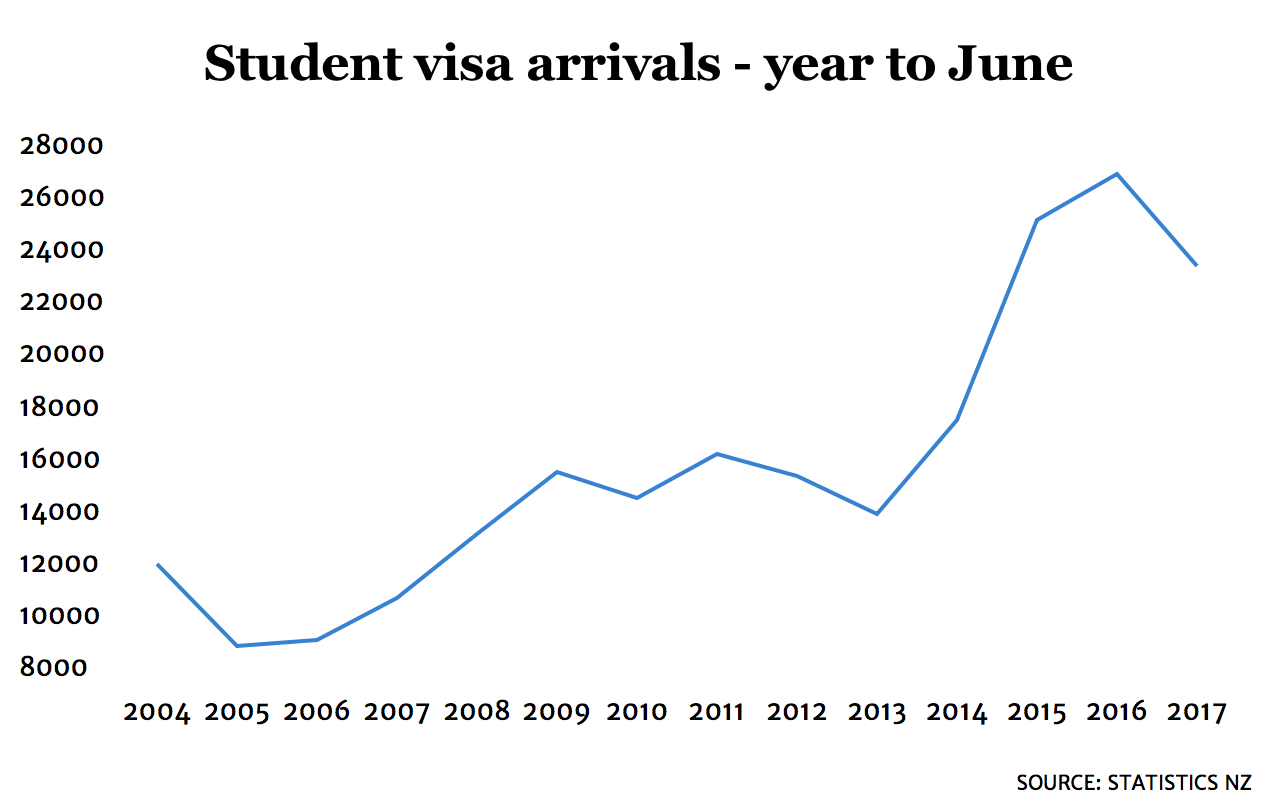
CHANGES WILL MEAN BETTER QUALIFICATIONS
Universities New Zealand executive director Chris Whelan welcomed the changes, saying it might reduce the number of students coming to New Zealand, but it would improve their outcomes.
"Rather than forcing students into some very shonky work arrangements, they can focus on finding proper, high-quality employment," Whelan said.
The proposed changes provided a good incentive for people to gain degree-level study, meaning they would be more likely to find "meaningful jobs for themselves, but also jobs that are meaningful for New Zealand".
Whelan admitted this would likely mean slightly better business for universities, which offered about 80 per cent of degree-level qualifications, but the financial gains would be "on the margins".
"If there are people who are still aspiring to coming to New Zealand, this may not be as cheap or as easy, but it's sure as heck going to lead to better outcomes for them."
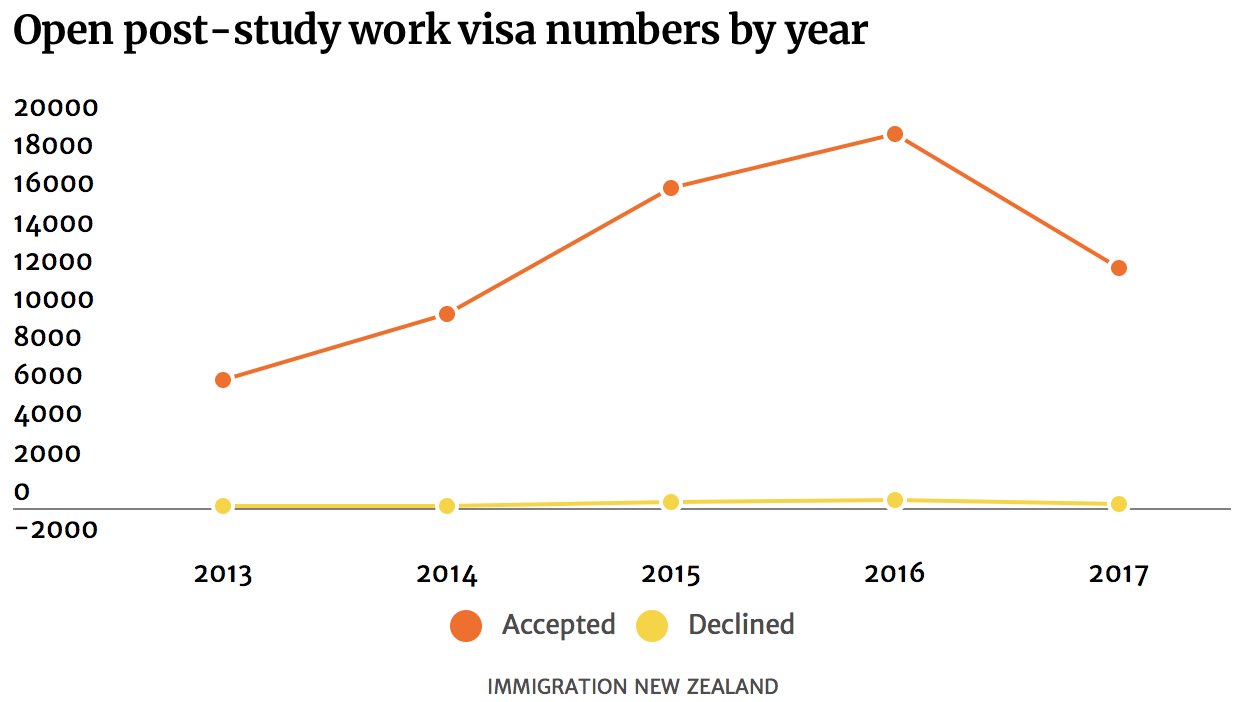
Immigration New Zealand granted 12,474 open post-study work visas last year, and declined 210.
A further 7,262 employer assisted post-study work visas were granted.
PROPOSED CHANGES
Remove the requirement for post-study work visas to be sponsored by a particular employer
Provide a one-year post-study work visa for non-degree level 7 or below qualifications
Provide a three-year post-study work visa for degree level 7 or above qualifications
Require students completing non-degree level 7 or below qualifications to undertake at least two years of study in order to gain eligibility for post-study work rights
Require international students studying level 8 or 9 qualifications to be in an area specified in the Long Term Skills Shortage List in order for their partner to be eligible for an open work visa, and in turn the partner's dependent children to be eligible for fee-free compulsory schooling
The public will have the chance to have its say on the proposed changes, with consultation opening on Tuesday.
If you are a victim of exploitation, or have witnessed behaviour that could be considered exploitation, you can call MBIE on 0800 20 90 20.
(Source: Stuff, Laura Walters)
TNC comments:
- In my opinion this is a clear example that the education sector who are "recruiting" students offshore, need to be licensed in the same manner as Licensed Immigration Advisers! In other words, the education sector should be required or obliged to use licensed immigration advisers.
- In my opinion, changing or restricting a post study work visa does not stop employers being greedy or would stop employers abusing immigrants. It is the employers who need to be taught what is fair and right! They need to be taught that exploitation is not right!
04/06/18 - Restaurateur frustrated by ridiculous lengths for employee work visa
Masterton restaurateur Travis Clive-Griffin wants to employ a foreign chef but he can't believe the hoops he has to jump through.
It could be a case of too many clauses spoiling the broth for a Wairarapa restaurateur who just wants to employ a good chef.
Masterton restaurant owner Travis Clive-Griffin said Immigration New Zealand has made it too hard to get a work visa for a prospective foreign worker and he has to reconsider whether it is worth the effort.
After finding it impossible to find a local person for the role at his restaurant The Screening Room, he gave a young Indian-born chef a spin in the kitchen to see if he would fit the bill.
Impressed with his skills and attitude, Clive-Giffin applied through the young man's immigration consultant to get a work visa transfer from the man's previous employer in Auckland.
"I couldn't find anyone like that here so I went down this process."
He first provided proof that he couldn't find a New Zealander to fill the position, such as showing evidence he had widely advertised for the position in print and online.
After the initial application was knocked back, Clive-Griffin said he was asked to provide an extraordinary amount of detail about his staff and the financial workings of his business.
This included the company's organisational flow chart showing the employees' positions, a list of the full names and birth dates of all current employees; the business's sale and purchase agreement, business forecasts and more.
Clive-Griffin threw up his hands in frustration and decided it was all too much of a rigmarole, but may yet reconsider whether the many hours of work required to collate the information would be worth the effort.
As the founder of award winning Greytown restaurant Bar Salute, Clive-Griffin said he has a long and reliable history as an employer and he has never had such hassles helping staff get work visas.
Immigration New Zealand manager Michael Carley said every visa application they receive is assessed against its own individual merits and relevant immigration instructions.
"Robust processes exist to ensure that there are genuinely no other New Zealanders available to do the job."
Immigration policy allows overseas workers to fill jobs when no New Zealanders are available, and/or when there are particular skill shortages.
"We encourage any employer having difficulty with an application to contact Immigration New Zealand directly for assistance."
Licensed immigration adviser Jasmine Bath of Immigration Guru is handling Clive-Griffin's prospect's case and questioned why the immigration service needed such detailed paperwork when a quick search could show the employer's history.
"I really knew this was going to annoy the employer. It's happened in the past."
She said the outcome of these applications can have a profound effect of people's lives and the immigration service should have very good reasons to make businesses jump through such hoops.
"I kind of had a feeling that Immigration want to turn off the employer by asking for so much information. That they want to pretty much scare the employer off so they can withdraw the job offer and that candidate for the visa will be the one that suffers."
Employer asked to supply:
- The company's organisational flow chart showing the employees' positions;
- A list of the full names and birth dates of all current employees
- Copy of sale and purchase agreement
- Business forecasts;
- The company's latest Interim Financial Statement;
- GST returns from when the business started operating to date;
- Company's PAYE statements from when the business started operating to date;
- Company's bank statements from 21 August 2017 to date;
- Any other documents which could support the sustainability of the employment.
(Source: Stuff, Piers Fuller)
30/05/18 - Immigration NZ accused of targeting Indian applicants
An immigration adviser says new figures are at odds with previous assurances that Indian students and graduates are not being targeted by immigration officials.
Immigration New Zealand says there has been no change to its assessments.
Figures show 14 percent of Indian applicants were rejected last year for the employer-assisted work visa, compared to 4 percent for Chinese applicants.
Arunima Dhingra, a director of Aims Global, said the number of post-study work visas were being "slammed" and genuine Indian applicants were suffering.
"They have gone through the right channels all throughout and yes there is tightening which is not said, not accepted, not disclosed and yet the numbers kind of show it.
"Because every time we've asked immigration 'what's happening? Are you singling them out? Is there a different way of processing applications for Indian nationals?' We've always had 'no, it's never that.'"
In the essential skills work visa category, 19 percent of declines were for Indian applicants.
Of those in the country unlawfully and appeal 922 of 2541 Indian applicants were approved, compared to 828 of 1232 Chinese applicants and 239 of 310 British immigrants.
There was a benefit of the doubt given to their European clients which was not extended to Indian applicants, Ms Dhingra said.
"I think the overall picture that's been painted is that, you know, 'Indian nationality applications, let's just go hard'," Ms Dhingra said.
"If immigration is doing that they need to stand up and explain that's what it is rather than say 'nah, nothing's changed', because clearly something has.
"Temporary visa applications can take months Applications for some temporary visas were often taking four months, she said.
"The figures show clearly that Indian students moving to work visas are not just targeted, but the numbers are being slammed. And in doing this extreme tightening, the genuine Indian students also end up paying and losing their entire career."
Harshmeer Kaur, who set up NZ Student Association Facebook page, said it was hard for international graduates now and there were long delays in visas being processed.
It used to take 10-15 days for a temporary visa, but it was now taking months, she said.
"I haven't heard anything from other nationalities, but a lot of Indian students are returning home because either their visa is being declined or they don't have the opportunity to present themselves properly.
"They are declining a lot of visas I don't know why. They're not even asking proper questions of the employer and they're making so many mistakes.
"Some of the visa [applications] are sent to China as well and I don't know what the immigration people over there do," Ms Kaur said.
"Because ... of all this happening, very talented people ... I have seen go back who would have been a great thing for New Zealand. But no, they've gone back now, gone back to India and doing good for India."
She believed immigration officers may be viewing Indian applications differently because of the previous concerns over lower quality education providers and fraudulent Indian agents.
Each application assessed on merits - INZ
An Immigration New Zealand (INZ) manager, Michael Carley, said each application it received was assessed on its merits and in-line with the relevant instructions.
"There can be a variety of reasons for why an application is declined - immigration officers are required to consider applications under the relevant policy, which includes health and character," he said.
But Ms Dhingra is unconvinced.
"The numbers leave INZ no room to hide behind 'no changed policies' anymore as the numbers speak loudest."
Immigration New Zealand documents released under the Official Information Act include discussion of half of private training establishment students coming from "migration-motivated markets", although it has redacted which countries these refer to.
Another report points out the risk immigration changes could be perceived as targeting particular countries, which could have the potential for impact New Zealand's foreign relations.
Officials from the Ministry for Business, Innovation and Employment and the Ministry of Foreign Affairs and Trade met with foreign missions including China, India and the Philippines to assure them that the changes were not targeted at any nationality or at international students.
A review of post-study work rights is underway.
(Source: Radio NZ, Gill Bonnett)
26/05/18 - Kiwi employer prefers hiring locals to highly qualified migrants
Our immigration system is flawed, with highly skilled and qualified migrants being approved who may not be suitable for New Zealand, an expert is warning.
A design professional and employer says he prefers hiring locals to highly qualified migrants.
Nigel Jones is a design professional and works in the company that had looked at employing skilled migrants."I interviewed a Middle Eastern man with incredible experience and qualifications, a guy who had designed entire cities," Jones said.
"However, he had no experience of our timber building systems, so would have been on a steep learning curve at the expense of a relatively small company."
He said migrants who get points for having certain qualifications had an "implied perception" that jobs were available for them.
But many immigrants also came with poor English language skills which he found to be "a huge frustration"."
I tend to favour people with local experience," Jones added.
The Weekend Herald reported today that frustrated migrants are giving up and going home because they say new immigration rules make it harder to work and stay in the country.
Immigration lawyer Kamil Lakshman said the way points were being awarded for skilled migrants was flawed.
She said the system was bringing in highly skilled and qualified migrants, but they may not be suitable for New Zealand.
Lakshman said points were being awarded based on "just the applicant's past" and did not take into account the present or how best suited the migrant was for New Zealand.
"The system is flawed and not robust, and many of the skilled migrants we see coming through may not be adequately placed for New Zealand."
"Top points are being given to people with top qualifications, but the question is are they what New Zealand needs."
Lakshman said little is done to settle, track or analyse the settlement success of migrants after a visa is issued.
In the year to April, more than 30,000 non-New Zealand citizens who had been here on a permanent or long-term basis had left. This is up 23 per cent from the year before.Massey University sociologist Professor Paul Spoonley said some who had left were frustrated immigrant job seekers who had given up.
He said there remained a reluctance among small and medium enterprise owners to employ migrants who did not have local experience.
New Zealand Association for Migration and Investment chair June Ranson said no system was perfect, but it was important to find a balance.
Ranson said many skilled migrants were also finding it hard to gain points for residency because they wanted to stay in Auckland.
"Tradespeople going to the Auckland area but holding no qualifications would find it exceedingly difficult to meet the points threshold as they lose points for being in that location," she said.
"The current points system was reviewed last year and it is obvious that it is slowing down the numbers."
Ranson said the 30,000 leaving also included those on working holiday visas, students and people on short term assignments and not just permanent residents.
"It comes down to what the Government wants to achieve, and how to move migrants into the regions and not Auckland," she added.
(Source: NZ Herald, Lincoln Tan)
26/05/18 - Tough rules see migrants give up and go home
Migration levels continued to fall from record highs in April - but slowly.Migration levels continued to fall from record highs in April - but slowly.
Some frustrated migrants are giving up and going home because they say new rules make it harder to work and stay in New Zealand.
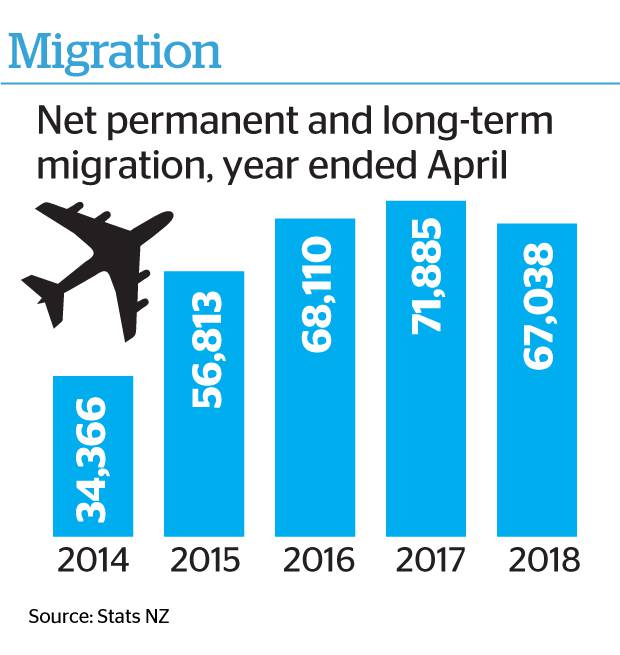
In the year to April, more than 30,000 non-New Zealand citizens who had been here on a permanent or long-term basis left this country - up 23 per cent on the year before, according to Statistics NZ.
As a result, annual net migration is down 4800 from a high point a year ago.Most were temporary migrants who arrived on student and work visas, experts believe.
Immigration policy changes introduced last year have made it harder for temporary migrants to gain residency.
"There is less enthusiasm for post-study options for international students, who are defined as permanent and long-term if they have been in New Zealand for more than 12 months," said Massey University sociologist and immigration expert Professor Paul Spoonley.
"But the Government has signalled that the labour market test is under review. This signals an intention to require employers to seek New Zealand workers before recruiting immigrants... particularly true for some areas such as hospitality and retail."
Spoonley said it was definitely the departures of non-New Zealand citizens that had contributed to the declining immigration numbers.
Donny Lai, 50, a former university lecturer from Hong Kong, will next week be returning home with his wife and young son after three years of struggling to secure a decent job.Lai describes himself as a "highly qualified IT professional" ande moved here in April 2015 because he believed the education system here was better for his 9-year-old son Justin.
But after sending out hundreds of job applications, the only work he could find was as a low-paid teacher in a private training establishment.
"We still love New Zealand, but it is just simply not possible to settle here when you cannot find a proper job," Lai said.
"The job market here is also too small for highly skilled people like myself, which is quite ironic because that is what immigration gives points for under the skilled migrant category."
Lai said most employers also would not give migrant workers who did not have local work experience a chance.
Kary Chung, 23, who last year told the Herald new rules made it impossible for her to meet visa requirements under the skilled migrant category, returned to Hong Kong for good last week.
Chung first came to New Zealand as a student at Takapuna Grammar School and last year graduated with a Bachelor of International Hospitality from AUT. She had been in the country for almost seven years.
Policy changes, which came into effect on January 15, meant migrants must be paid at least $24.29 per hour to be considered in skilled employment. Pathways to residence for temporary migrants have also been cut back.
Chung's partner Ivan Shum, 24, a Massey University business graduate who also arrived as a high school student at Takapuna Grammar, also left the country permanently yesterday.
Spoonley said there were many "frustrated immigrant job seekers" who were giving up on New Zealand.
He said there remained a reluctance among small to medium enterprise owners to consider any applicant who did not have local experience.
Immigration Minister Iain Lees-Galloway said this was a "flow-on effect" of the high migration that occurred under the previous Government.
"What we're seeing here is a significant cohort of temporary migrants and those on student visas with post-study work rights leaving the country as their visas expire," Lees-Galloway said.
"I don't accept that immigration should necessarily fill shortages in industries like hospitality and retail when the underemployment rate remains high at around 12 per cent, meaning there are plenty of New Zealand workers looking for more work."
Lees-Galloway said the Government remained committed to making sure the immigration system works for New Zealand.
The Government's plans on how the system would be better targeted for the growth of regions and industries would be announced soon, he said.
"It is clear that there are industries that are key to this country's growth, like construction and dairying for example, that need migrant workers especially in our regions," said Lees-Galloway.
"We remain committed to ensuring that when businesses have a genuine need for skilled migrant workers that they'll get the workers they need."
Eric Chuah, founder of Cultural Connections, said sometimes migrants faced difficulties because they were not fully aware of the services and organisations out there to help them settle and find employment.
In 2014, Chuah started the ANZ Migrant Expo when he was head of migrant banking at the bank. The next expo will be held on June 16 at The Cloud, which will focus on employment and start-up business.
"The expo serves as a single platform to help migrants access the info they need, and connect with the right organisation for opportunities, upskilling and networking," Chuah said.
Restaurant Association chief executive Marisa Bidois said it would be a worry for the industry if New Zealand became less attrative to migrant workers.
"As long as we are still able to access the required workers through temporary visas, the trend is not alarming yet," Bidois said.
"However if the decline continues and New Zealand becomes a country that is for whatever reason less attractive to overseas workers, this could up significant pressure on an already challenging recruiting environment."
The net migration gain of 67,000 migrants for the April 2018 year returns migrant flows to a level last seen two years ago.
The gain for the year was made up of 130,500 arrivals and 63,400 departures.
"Interestingly, the number of arrivals increased in the April 2018 year, so it is the larger increase in departures that drove the lower net migration level," population insights senior manager Brooke Theyers said.
More than 98,000 non-New Zealand citizens arrived but more than 30,000 non-New Zealand citizens left over the same period.
(Source; NZ Herald, Lincoln Tan)
23/05/18 - Why more employers are bringing skilled migrants to NZ
More employers are getting the green light to bring in skilled migrants, bypassing previous requirements to seek New Zealanders first.
In the 2016-2017 financial year 716 were given clearance to do so but that's increased more than 25 per cent to 899 so far this financial year. With a building boom in full swing and skilled workers in hot demand many companies in the construction sector are taking up the chance.
The LookSee Build programme has helped organisations like Auckland Transport and Downer find upper-level and highly skilled talent offshore and its director Hamish Price said businesses were being left with no choice but to look abroad.
"The demand to deliver the work in the public and private sector has outstripped the supply and then on top of that, there's work that hasn't been done in this country before," Mr Price said.
"The experience to deliver that work requires talent from overseas that actually has the experience to do it."
The construction industry expects it'll need an extra 50,000 workers over the next four years to keep up with demand.
Mr Price said employers saw the offshore option as a "really viable path" to get through the backlog of work.
Employers who regularly recruit skilled overseas staff can apply to become accredited - allowing them to employ migrants on talent visas. To do this they must meet criteria around their financial position, workplace practises, and have demonstrated a commitment to training and employing New Zealanders.
Association of Migration and Investment chair June Ranson said it was a thorough process which had benefits for employers.
"They don't have to keep repeating the strenuous requirements for when they offer purely an essential skills visa because Immigration has in fact already established this is a legitimate employer."
Some were turning to accreditation after frustration with the considerable time it took to go through the visa process, she said.
Increasing migration good for industries that need workers
While the Labour government promised to cut down on net migration by targeting student and post-study working visas, the number of highly-skilled workers increased more than 10 percent.
Between April last year and March this year 40,293 Essential Skills and Accredited Employer visas were granted, up from 35,775 the year before.
Employers and Manufacturers Association in Auckland head Kim Campbell said this was good news for industries screaming out for workers.
Council of Trade Unions president Richard Wagstaff said the accreditation system needed to be more thorough.
"We're concerned that many employers could be taking a shortcut which prevents them from employing New Zealanders and up-skilling them. It's just too easy to get migrant labour when there are thousands of New Zealanders who want work."
Immigration Minister Iain Lees-Galloway said the government was focused on making sure the system was fit for purpose.
Proposals around the accredited employer scheme would be brought before for public for consultation, he said.
"Those will be designed to ensure they're working well, that they put New Zealanders at the front of the queue and that they are designed to ensure employers can get the people that they need."
(Source: RNZ, Tom Furley)
08/05/18 - Labour shortage declared in Bay of Plenty as 1200 more people needed to pick and pack 20 million trays of kiwifruit
The Ministry of Social Development has today declared a seasonal labour shortage across the Bay of Plenty, saying an additional 1,200 people are needed to pick and pack an extra 20 million trays of kiwifruit this season.
Worker shortage in kiwifruit industry prompts Government to declare labour shortage in BOP
The declaration will be in place from today until June 8 and follows discussions with sector leaders, industry experts and other Government agencies, the ministry said.
Regional Commissioner Mike Bryant says by declaring a labour shortage, people from overseas with visitor visas can apply for a Variation of Conditions to allow them to work through the declaration period, he said.
Mr Bryant says a number of factors led to the labour shortage being called, including a strong kiwifruit season, a decrease in the number of international students in the region, a bounce back from the PSA virus impacting crop volumes and varieties, and a relatively low unemployment rate of 5.1 per cent in the region.
"To date around a third of this year's crop has been picked and packed, however the industry's entering the main packing period and more people are needed to help with work," Mr Bryant said.
The forecast volume for this year's kiwifruit harvest is about 142 million trays, a 19 per cent increase from last season's crop of 120 million trays. The SunGold variety of kiwifruit, which accounts for 44 per cent of total crops, also requires picking in a shorter time-frame and means more reliance on fruit pickers during this period.
MSD says between January and April this year, it placed more than 1,000 people into job vacancies in the kiwifruit industry through providing work brokerage support, training, up skilling opportunities, financial and case management support.
"We estimate between 80 to 100 additional people from our Western Bay of Plenty Work and Income sites suitable for seasonal employment that could be used to meet the labour shortage. However more workers are still needed, because our clients alone won’t fill the estimated 1200 job vacancies in the industry," Mr Bryant said.
The Bay of Plenty already has a strong presence of about 2000 Recognised Seasonal Employer (RSE) workers in the region.
(Source: 1News)
06/05/18 - Immigration Minister downplays KiwiBuild visas for illegal migrants but has post-Budget proposal for construction industry
Unlawful construction workers have been targeted for deportation in Operation Spectrum.
Secret report Operation Landing laments the supervision and quality on building sites in Auckland which will "increasingly be more challenging in the years ahead".
Illegal overstayers with construction skills could be allowed stay in New Zealand to help build the 100,000 homes promised by the Government's flagship KiwiBuild project.
The construction industry was already struggling to find an extra 56,000 workers by 2022 to cope with demand, according to a Ministry of Business and Innovation report published last year.
The Labour-led government wants to build 100,000 affordable homes within 10 years and Immigration Minister Iain Lees-Galloway has already signalled more migrant tradies will be needed to build them.
But the shortage of skilled workers in New Zealand means an illegal workforce has flourished.
In one case, nearly 200 illegal Malaysian workers were deported, fled the country or stopped at the border following a six-month investigation into Auckland's construction industry, the Weekend Herald revealed in February.
Investigators from Immigration New Zealand targeted 10 companies to disrupt the flow of illegal workers from Malaysia, who were responding to advertisements on social media.
Operation Spectrum raided construction sites around Auckland and detained and deported 54 people who were working unlawfully as plasterers, painters, tilers and carpenters.
But instead of being deported, illegal workers with construction skills might now be granted visas to work on the KiwiBuild project.
The idea has been raised with the Minister and discussed within Immigration New Zealand, according to several sources.
This was downplayed but not denied by a spokesman for Mr Lees-Galloway.
"We're not considering that right now. The Government will have some proposals for consultation coming out in the near future relating to construction industry and we'll look forward to hearing views from the public and business community," the Minister said in statement.
The proposals are unlikely to be made public until after the Labour-led government's first Budget is announced on May 17.
There were 747 people unlawfully in New Zealand deported in the 2016/17 financial year, as well as another 1437 who left "voluntarily".
But it is unknown how many had building or construction related skills.As part of its election campaign, Labour - as well as New Zealand First and the Greens - promised to cut net migration.
A "KiwiBuild" visa was also discussed, where residential building companies could get a three-year visa for skilled migrants as long as they trained a local apprentice as well.
Michael Woodhouse, the National Party immigration spokesman, said Labour would be "hypocritical" if it allowed unlawful builders to stay in country after campaigning to cut immigration.
"There is no good reason to legitimise a person's immigration situation just because the construction industry is short of people," said Woodhouse.
"Amnesties don't work. That leads people to think if they if they stick around long enough, they'll eventually get a valid visa. That causes more unlawful migrants, not less."
Operation Landing
The Herald on Sunday has also obtained an MBIE briefing about a sting on residential building sites across Auckland.
Operation Landing, which involved multiple government agencies, targeted 152 new homes being built in the North Shore and south Auckland over a two-week period in 2016.
Among the key findings was limited supervision and oversight by qualified tradespeople, leading to poor building practices.
Four out of five building sites visited did not have a "licensed building practitioner" - who can carry out weathertightness work - present.
Investigators found problems with supervision of plumbing and gasfitting, including unlicensed work, on nearly 30 per cent of sites.
Consented building plans were missing from up to 80 per cent of sites, while only 42 per cent of sites were meeting their employment obligations.
The workforce on each of the 152 building sites were broken down into "major ethnicities" with nearly 65 per list listed as "Asian/Chinese".
It was "very likely" a number of building sites were involved in the cash economy and not paying tax to Inland Revenue.
The conclusion of Operation Landing was "that the Auckland new residential build sector has a number of regulatory issues and challenges".
"Notwithstanding the credible job undertaken by Council building inspectors to ensure the new build residential construction meets the standards set in the Building Code, a number of significant issues exist ... which potentially undermines the quality of the build," the MBIE report author Mike Hill wrote.
"There is clear evidence that the consents for new dwelling builds are rising each year, which requires more workers.
"The source, capability, qualifications, supervision and management of existing workers currently present problems. This will increasingly be more challenging in the years ahead."
(Source: NZHerald, Jared Savage, Investigative reporter)
27/04/18 - Too many tourists? What Kiwis really think
New Zealanders remain positive about the impact of tourism on this country, and there's been a slight drop in the percentage who say there are too many visitors.New Zealanders remain positive about the impact of tourism on this country, and there's been a slight drop in the percentage who say there are too many visitors.
The six-monthly Mood of the Nation research, commissioned by tourist bodies, finds that 56 percent of the 500 surveyed "strongly agree" that international tourism is good for the country and 41 percent "agree".
The research is funded by the Tourism Industry Aotearoa (TIA) and government-funded Tourism New Zealand. It found 22 percent say there are too many international visitors, down 1 percent on the last survey in November last year.
However, that is up from just 13 percent worried there were too many visitors less than three years ago.
Since then visitor numbers have soared to nearly 3.8 million a year.
Concern that tourism growth was putting pressure on New Zealand also dipped slightly from 40 percent to 39 percent of respondents in the latest survey.
The top three concerns about the impact of tourists were:
- Increased traffic congestion (41 percent),
- Risk of serious road accidents (39 percent) and
- Results in a higher number of road accidents (35 percent)
Perceived benefits were:
- Economic growth in the regions (60 percent), \
- Growth opportunities for businesses (59 percent) and
- Creates employment opportunities for residents (52 percent).
TIA chief executive Chris Roberts said the greatest value in the survey was the tracking of public sentiment over time.
"Since we initiated the Mood of the Nation in 2015, we have had very strong arrivals growth and a corresponding increase in public concern about things like pressure on infrastructure and congestion," he said.
"It is heartening that this trend has levelled off in the latest survey and overall sentiment has slightly improved."
The survey showed 91 percent of New Zealanders are proud New Zealand is seen as an attractive visitor destination and 88 percent took pride in making visitors feel welcome in New Zealand.
Pressure on infrastructure was the top concern New Zealanders had with international tourism; other concerns include accommodation shortages, environmental damage, freedom camping, traffic congestion and road safety.
Queenstown and Auckland continued to be seen as the areas under the most pressure from international tourism by residents. Perceptions from Queenstown tended to be more negative than in the other centres surveyed.
Tourism New Zealand chief executive Stephen England-Hall said making sure high-value visitors chose New Zealand was the top objective.
"To do this, we target our marketing, PR and trade activity to high-yield markets such as Australia, China and North America and solely focus on promoting shoulder season travel so that spend is spread more evenly across the year, instead of just peak season."
While our landscapes capture the imagination of prospective visitors to Aotearoa, it is manaakitanga, the very Kiwi act of hospitality and sharing, that sets New Zealand apart on the world stage as a highly desirable visitor destination and brings visitors back time and time again."
The research, undertaken by Kantar TNS, was conducted in March 2018.
Roberts said the tourism industry acknowledged that the rapid increase in visitor numbers has caught some communities by surprise and created some challenges. The industry was working with central and local government to respond to these challenges.
There had been a boost in funding for local infrastructure such as car parking and toilets in regional centres in the last budget but so far the new Government has been quiet on plans for the industry.
Before the election Labour floated the idea of a tourism tax to help fund facilities.International tourism contributes $14.5 billion a year to the economy and directly or indirectly employs one-in-seven New Zealanders.
(Source: Otago Daily Times, NZME)
24/04/18 - Liam Dann: Slower migration hides Ardern's elephant in room
Migration pressure is easing - very slowly - but perhaps enough to suffocate the elephant in the room for the Prime Minister before she is forced to tackle it head-on.
The annual net migration gain - the number of new people in the country when you subtract departures from arrivals - fell to 67,984 in the year to March.
That's about 4500 below the record peak last July - not much, but just the enough for the Government right now.
Immigration policy has been an awkward thing for the Labour Party since it hitched a ride on NZ First's anti-immigration wave last year under Andrew Little's leadership.
Jacinda Ardern softened the rhetoric but broadly did not back away from Little's suggested cuts of 20,000 - 30,000 to annual net migration.
Labour's stance has even earned Ardern unfavourable and unfair comparisons to Donald Trump.
In reality though, Labour has not been quick to act on any new immigration policy other than to tighten up on rules for student visas.
That's because it has become clear that going cold turkey on net migration gains would stall an already slowing economy. Ironically, it would slow the building of new housing and infrastructure needed to meet the growing population.
One suspects the lack of action is also because an anti-immigrant stance has never sat well with Ardern and the more progressive end of the Labour party - the team currently running things.
However, the coalition agreement with New Zealand First (which ran with anti-immigration rhetoric and suggested more radical cuts to a net gain of 10,000) has kept some pressure on.
For the business community and many economists, the absence of further policy calls on immigration has been seen as the elephant in the room - the cause of great uncertainty.
A major decision in one direction or another could have a dramatic bearing on forecasts and business confidence.
But the gentle downward trend of the past nine months could provide a sweet spot for Labour.
Most economists expect the net migration number to keep falling slowly.
ASB expects the net gain will be down to around 50,000 in 2019.
That's within Labour's pre-election target without requiring any fresh moves.
Economists with slightly gloomier outlooks - like Wellington-based Infometrics - see net migration falling as low a 17,000 by 2021.
More significant than any current policy changes is that as the global economy - particularly Australia - picks up relative to New Zealand, the historic trend is for more New Zealanders to leave and fewer migrants to arrive.
According to Stats NZ, last month actually saw more migrant arrivals while the net figure fell because more people left.
Across the year and even on a three month averaged basis, permanent long-term arrivals are falling.
History suggests that migration trends can shift quickly - probably faster than even New Zealand First would like.
New Zealand in the past 50 years has had numerous periods of net migration losses - almost always coinciding with tough economic times.
That's one of the reasons that National under John Key trumpeted gains as a success story.
It is worth noting, even if we see net migration falling by 30,000 this electoral cycle, we'll still be dealing with historically unprecedented numbers of migrants.
Current gains are nearly three times higher on a per capita basis than that of pre-Brexit UK.
In absolute terms, they are larger than the waves of colonisation New Zealand saw in the last 19th and early 20th century.
The social pressures and changes that this decade of growth have created can't be ignored.
But radical policy responses are risky because a sudden cut in migration could leave us with a stalled economy and no less pressure on current infrastructure and housing.
Managing the curve requires subtle and nuanced policy tweaks, shifts in the kind of skills required - more builders, more construction workers.
These aren't the kind of policy shifts that grab headlines in an election year.
However, they are the kind of sensible, balanced calls that this current softening cycle should allow the Government to make - without fulfilling businesses worst fears and road blocking economic growth.
(Source: NZ Herald, Business Desk, Liam Dann)
24/04/18 - Annual net migration eases back but remains high at 68K
New Zealand's annual net migration slowed in March as continued high immigration was offset by more Kiwis and non-citizens leaving.
Annual net migration was at 68,000 in the year to March, from 71,900 in the year to March 2017, Statistics New Zealand said.
Monthly net migration has been in flux this year, having risen to a seven-month high of 6,210 in January, causing market watchers to question whether the trend of declining net migration had reversed or whether the month was an anomaly. The figure dropped back to 4,970 in February, lower than any month in 2017, while in March, monthly net migration recovered to 5,480.
There was a 0.1 percent drop in non-New Zealanders immigrating in the March year to 98,800, compared to the February year, and a 2 percent lift in the number of non-New Zealanders leaving to 29,700, leading to overall net migration of non-New Zealanders of 69,100. A net 1,100 Kiwis left in the latest year, reducing total net migration to 68,000.
"More non-New Zealand citizens are leaving," Stats NZ population insights senior manager Brooke Theyers said. "But there are just as many migrants arriving as a year ago."
New Zealand has been experiencing record levels of net migration in recent years, which made rising immigration a key election issue as it strains the country's infrastructure and is blamed for inflating property markets. Net migration peaked at 72,400 in the July 2017 year.
"Smoothing through month-to-month volatility, net migration has been easing back since mid-2017," said Westpac senior economist Satish Ranchhod in a note.
"Looking forward, we expect that migration will continue to ease back over the next few years. Much of the increase in migration in recent years was due to people arriving on temporary work and student visas. We are now seeing many of those earlier arrivals departing. We expect that this will continue for some time yet."
Increasing numbers of migrants came on work visas in the latest year, up 6 percent to 46,300, with residence visa numbers down 13 percent to 15,000 and student visas dropping 0.1 percent to 23,800. China continued to be the biggest source of migrants on residence visas, though that dipped 17 percent to 2,800 in the year, while the United Kingdom was the biggest source of work-visa migrants, up 1.1 percent to 7,400.
Despite the drop in residence visas granted, Chinese migration remained the largest on a net basis, with 8,500 of net arrivals coming from China, though that was down 16 percent on a year earlier. India was the second-largest source at a net 6,900, though Indian net migration was also down 14 percent from a year earlier.
Short-term visitor arrivals, which include tourists, people visiting family and friends and people travelling for work, reached 3.8 million in the March year, up 8 percent from a year earlier.
(Source: NZ Herald, Business Desk)
Covid 19 Notice
As the impact of the coronavirus continues to evolve, we face this unprecedented situation together. The pandemic is affecting all of us. At Terra Nova Consultancy Ltd we wish to reach out and update you on how we are addressing it. Our top priority is to protect the health and safety of our employees, clients, and our communities. Our focus on customer service remains at the center of everything we do, and we are fully committed to continue to serve you with our services, and striving to provide our services without interruption.Please listen and act upon the advise given by the Government, only in that way will we together be able to combat this challenge. And as always, stay healthy and keep safe.
TNC E-books
The Terra Nova e-book page contains publications in e-book and e-news format containing comments and reviews from Terra Nova Consultancy Ltd, and other contributors, that relate to a number of issues from immigration to operating a business.
Some of the Terra Nova e-books e-book and the Terra Nova e-news issues we believe may be quite helpful for prospective immigrants.
Check back regularly to find new editions of our Terra Nova e-book and Terra Nova e-news range.
Quick Links
Translate this site
Contact Details
Terra Nova Consultancy Ltd
165A Old Railway Road
Kumeu
New Zealand
Please arrange visit by appointment.
Mobile: +64 275 706 540
Postal Address:
as above
Licensed Immigration Adviser
Johannes Petrus (Peter) Hubertus Cornelis Hendrikx

License number: 200800214
Is your Immigration Adviser
licenced by the NZ Government?
Click here for details www.iaa.govt.nz