
.|

NEWS
A variety of immigration, business and general news articles taken from New Zealand newspapers, websites and other sources (sources are mentioned at the bottom of each article) and selected by Terra Nova Consultancy Ltd. It may assist the reader being more or less up-to-date what is happening in Aotearoa, "the Land of the Long White Cloud". Happy reading, enjoy ... and if you have any questions on these updates - please contact us...
Newest article always on top.
22/11/17 - Migration over the peak - tipped to fall further
Economists remain confident that New Zealand's annual net migration gain is trending down despite a small bump in the year to October.
New Zealand saw a net gain of 70,700 migrants for the year ended October 2017, with 131,600 migrant arrivals and 61,000 migrant departures, Stats NZ said today.
That was 400 more October 2016 but was lower than the peak of 72,400 in the July 2017 year.
In a report today Westpac's Satish Ranchhod said net migration could fall to as low as
10,000 by 2021.
ASB economist Mark Smith forecast a fall to below 40,000 people by the end of 2019 and under 20,000 by the end of 2021.
Finance Minister Grant Robertson said Westpac's estimated fall in net migration went further than Reserve Bank and Treasury estimates.
He said the Government approach to immigration would eventually see net migration track downwards.
"The exact numbers that then flow from the change of settings, we'll see over time."
The October statistics showed an uptick in new arrivals and returning New Zealand citizens.
"However, this looks like normal month-to-month volatility," Ranchhod said.
"Looking at the longer trends, the uptrend in both of these flows was arrested earlier this year," he said.
"Looking at the breakdown of the monthly flows, a continued trend decline in net migration looks to be on the cards for the coming year."
ASB's Smith noted that despite the October lift, the trend (3-month average) in net permanent and long term (PLT) monthly arrivals continued to ease from historically high levels.
At about 5,413 people October was well below the 6,200 peak achieved late last year.
Annual net PLT arrivals fell to 70,694 people, still high in a historical sense, but the lowest annual total for any month in 2017.
"The outlook is for a continuing moderation in net PLT inflows, as policy changes trigger a moderation in net non-NZ resident arrival numbers," he said. "Whilst departure levels are expected to lift from historically low levels given the strengthening global outlook and Australian labour market.
The trend in departures was interesting, said Westpac's Ranchhod. Departures of New Zealand citizens had levelled off.
"However, departures of non-New Zealand citizens have been steadily rising since mid-2016 and are now 30 per cent higher than this time last year. This group includes people who would have come over in recent years on temporary work and student visas," Ranchhod said.
"Typically those who come over on these programs stay for around three to four years. Given that the surge in foreign arrivals began in 2013, we have been expecting to see a corresponding surge in departures," he said
"Combined with likely changes in Government policy, we expect that the above trends will see annual net migration will drop from around 70,000 now to 10,000 in 2021," he said.
"Most of this change is due to natural forces that drive net migration (like the strength of the global economy), rather than policy."
Prime Minister Jacinda Ardern said immigration was not in the Government's 100-day plan and it would take some time before net migration dropped.
She said it was important to get the settings right, rather than focus on a specific number.
(Source: NZHerald, Liam Dann, additional reporting Derek Cheng)
21/11/17 - Strained immigration tribunal calls for support
The number of appeals against deportation by non-residents has risen 59 percent following a crackdown on foreign-born criminals.
The Immigration and Protection Tribunal last year dealt with the highest number of appeals in its history. Its annual report said it urgently needed to add to its 16.4 full-time equivalent staff and improve resources.
The report showed it managed to reduce the number of appeals waiting to be heard despite an overall 30 percent rise in cases being lodged and more lengthy refugee and investor category appeals.
It said its chairman last year concluded almost 300 cases - nearly a quarter of the tribunal's appeals - and that workload was not sustainable.
"The tribunal reduced the time taken, from date of lodgement, for disposable appeals to be finalised by a record 36 percent. Appellants are now waiting an average of 56 days less to receive the outcome of their appeal than at the start of the court year," the annual report said.
"The work pressure on the tribunal has also highlighted the urgent need for the Ministry of Justice to develop terms and conditions for tribunal members, so that legitimate expectations can be clarified for the benefit of the members and the ministry."
The report revealed that a confidential counselling service was made available to members from last November for work-related issues due to the intense and stressful nature of some of its work.
It also said the tribunal ability to function effectively was being undermined by the ongoing problems affecting its database of published decisions, which is the primary reference point for tribunal members.
"This year, the tribunal's database has suffered significant problems, with the search engine failing to function properly and the ministry lacking resources to cope with the uploading of the tribunal's decisions," it added.
"These problems remain unresolved, and, at present, uploading of the tribunal's decisions is some six months behind.
These issues seriously affect the quality of the tribunal's work and its public service, and it is hoped that the coming year will see them resolved as a matter of urgency."
It said more resources would now be directed at hearing appeals against deportation by non-residents to help address their growing numbers.
The report said the increase in the volume of new appeals appeared to be associated with recent changes in the application of immigration policies.
Two years ago, the Law Society said Immigration New Zealand had been slow to issue deportation liability notices to visa holders who were convicted of a crime but that was now changing.
Of the decisions released in the past year 64.7 percent of appeals were declined, 29.6 percent of appeals were allowed, and 5.7 per cent - all residence appeals - were referred to the Minister of Immigration as special circumstances were identified despite Immigration New Zealand's decision being correct.
The lowest percentage of successful appeals were in the deportation (non-resident) stream where a quarter or 103 cases were approved.
(Source: RNZ, Gill Bonnett, Immigration Reporter)
16/11/17 - Something Extraordinary Is Happening In The World, And Most People Haven’t Noticed
I got tired of being tied to a meaningless routine, so I cut myself free. I moved away from societal attachments and the FOMO that tied me this humdrum.
Ever since, my mental horizon has shifted 180 degrees. I am able to see the world in a new light, and a lot of new things have become obvious to me.
The world is transforming gradually, and most of us have been blind to it all along.
Here are the reasons why I believe this change is ongoing:
1. NO ONE CAN STAND THE EMPLOYMENT MODEL ANYMORE
The job-world is unsatisfactory to the maximum. All the gold promised to us in adulthood is slipping away. Hordes of people are quitting in order to invest their time in a start-up. It is true that big companies demand a lot from their employees. But it is necessary to give them a working arrangement and space where their brain can breathe. Post the Industrial Revolution, even men are expected to act as machines.
2. THE ENTREPRENEURSHIP MODEL IS ALSO CHANGING
Once you have quit your suffocating job, you begin to feel better. The first thing to do is make a blueprint of your new venture. Then an investor comes along, after a lot of lobbying and anticipation. Once his/her money has been poured into your project, you’re at their mercy again. You have to run by their likes and dislikes, work by their rules and guidelines, and ultimately find yourself stuck with exactly what you ran away from. This vicious cycle needs to end.
3. THE RISE OF COLLABORATION
This was a repetitive Mathematics problem through out my childhood: If 8 men take 2 hours to build a wall, how long will 16 people take to build that same wall?
When you work together, the work load lessens, and it also gets done faster. In this age of complete alienation, why would you block your fellow employees out? Collaborative ventures are on the rise again, and it makes me really ecstatic to see that people are beginning to understand the value of sharing.
4. WE ARE FINALLY STARTING TO UNDERSTAND WHAT THE INTERNET IS
The reach of the digital medium is supreme. It is only now that we have begun to acknowledge it. It is instrumental in demolishing divisions between races, languages, social status, et all.
Like the Arab Spring, it could also be an important tool in nationalism.
In the age of the Internet, you are spoiled for choice. Beyond the limitations of the TV, or biased news, you can now access whatever you want to, online. It also gives a stage to the oppressed.
5. THE FALL OF EXAGGERATED CONSUMPTION
Capitalism wanted to take all our money. For the longest time, we have been brainwashed into buying the most useless things in the market. Attractive advertising and the thirst for social hierarchy beggared us.
But people have become more conscious now. Owing to waves of lowsumerism, healthy and natural food, recycling, etc, our lives and the environment are looking much better than it did a couple of years ago.
6. HEALTHY AND ORGANIC EATING
All the MNCs have wrecked our food habits. I admit that KFC and McDonalds taste really good. But not all things that taste good are necessarily good for your health.
Finally, consumers have realized the garbage they’ve been accepting as food. Owing to great media coverage, and science, we have become more aware and conscious of what goes into our body.
You will be surprised to know that your habit affects the economic future of your country. Your healthier choice forces the MNC to cater to your need, thereby giving the power back to the peasants.
7. THE AWAKENING OF SPIRITUALITY
Relaxing is extremely important. One must learn how to unwind in order to lead a healthier life. In this loud rush we call life, we’ve forgotten to allocate time to ourselves.
You don’t necessarily have to meditate for an hour or more. Start with 10 minutes a day, and work your way up. Trust me, you’ll fall in love with how calm it makes you feel.
8. UN-SCHOOLING MOVEMENTS
The education system needs a lot of reform. I could scream this from every mountain-top in the whole wide world if I need to. Instead of making children interested in learning, we’ve created an entire generation that is scared of going to school. Whatever happened to freedom? To the joy of learning? To teachers you could actually look up to? Kids are force-fed classes they don’t want to take, and we keep shoving homework down their throats even during holidays. I mean, let them breathe!
There are a few groups trying to replace this practice with homeschooling, un-schooling, hack-schooling, et all. I truly hope they succeed, and that larger establishments learn a thing or two about how to teach children.
Gradually, everybody is beginning to realize what a strange world we live in. Some of us are even trying to make a difference. More power to them!
(Source: Simple Capacity)
13/11/17 - Scorching early summer on its way
Everywhere south of Auckland can expect some early beach days in November.
Much of the country will see an early start to summery weather in the coming weeks.
Niwa tweeted on Monday that a "very impressive" high-pressure dome, fuelled by La Niña, is likely to hang over the South Island and central-lower North Island for the rest of November.
A very impressive, LaNiña-driven, dome of high pressure is forecast to persist over the South Island & central-lower North Island for much of the rest of November.
It's predicting near-record heat levels in the south and potentially some early beach days for everywhere south of Auckland.
Niwa meteorologist Chris Brandolino told NZME that, over the next week, the South Island could expect temperatures 10-15degC above average.
"This time next week, that's when I think the conversation really starts to heat up."
Temperatures could reach near or above 30degC in some parts of the country.
While that's good news for beachgoers, farmers might be less pleased about summer's early arrival.
Mr Brandolino says the combination of high temperatures and the lack of rainfall could have a severe impact on the agricultural sector.
(Source: Newshub)
02/11/17 - Unemployment falls to eight-year low as job creation surges
Unemployment has been gradually falling since 2012, despite record gains from net migration.
A surge in the number of jobs in the New Zealand economy has the Opposition calling on the Government to review its stance on immigration.
On Wednesday Statistics New Zealand figures showed unemployment fell to 4.6 per cent, the lowest in almost nine years. The survey showed that the economy added more than 100,000 in a year.
Covering the three months to the end of September, marking the final weeks of National's nine years in office.
National finance spokesman Steven Joyce said large parts of the country now had unemployment below 4 per cent, and some parts were below 3 per cent, meaning the economy was "getting close towards full employment".
"You really are getting short of people. It's important the new Government recognises that and is aware that if they follow through with their migration policy, that would actually choke off growth in some regions of the country."
A large number of industries were reporting difficulty finding staff, Joyce said, and even Labour had hinted at needing to use migration to fill plans to increase construction levels.
"I'd invite them to cut to the chase and say 'we need skilled migration to keep up the growth in the New Zealand economy'."
Participation in the labour force rose to 71.1 per cent, while the employment rate rose to 67.8 per cent, both record highs.
The number of people unemployed stood at 126,000, which is actually slightly higher than the number unemployed back at the end of 2015, but now the workforce is substantially larger with another 221,000 people employed.
Employment Minister Willie Jackson welcomed the lower unemployment rate, but said more could be done. The unemployment rate for Maori (9.9 per cent) and Pacific peoples (9.4 per cent) was "completely unacceptable" Jackson said.
"It is currently around three times higher than that of New Zealand Europeans, and this must improve."
Jackson promised talks with "relevant organisations" such as unions, iwi and Business New Zealand in the coming weeks.
"Partnering with them will be a key component in shaping a forward focused employment policy which improves outcomes for all New Zealanders."
Wednesday's release showed contrasting employment fortunes for men and women.
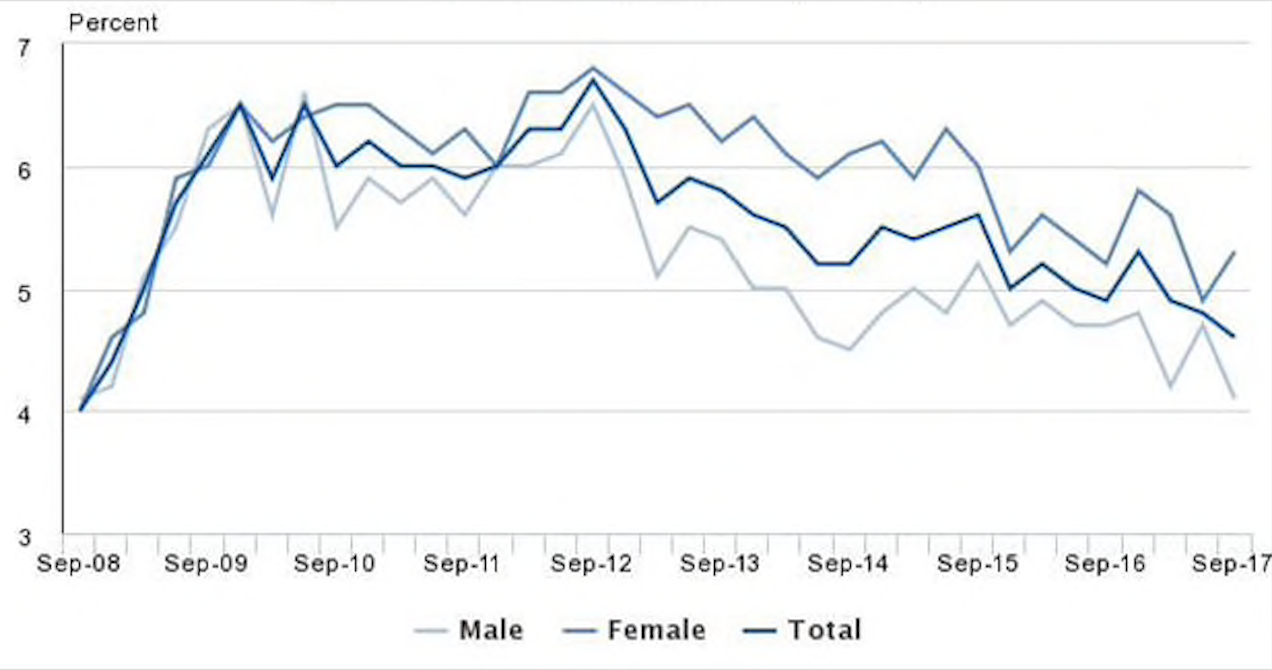 Source: Statistics NZ
Unemployment among men dropped to 4.1 per cent, a drop of 0.6 percentage points, while unemployment among women (which tends to be higher than for men) rose 0.4 points to 5.3 per cent.
For Maori, unemployment fell to 9.9 per cent, the lowest rate since 2008, while unemployment in the Pacific peoples category dropped to 9.4 per cent.
Regionally, unemployment is lowest in an area covering Nelson, Tasman, Marlborough and the West Coast at 2.2 per cent, down from 2.8 per cent a year ago.
Underutilisation
Statistics New Zealand also publishes an underutilisation figure, designed to reflect the number of people who are working, but would like to work more.
The figure has taken on a higher importance in recent weeks, after the new Labour-led Government ordered a review of whether measures of unemployment were appropriate for current conditions.
Although the Government does not appear to have commented on the review publicly, the review appears to stem from NZ First leader Winston Peters concern that the unemployment figure may paint a flattering picture of the job market.
In the September quarter, the underutilisation rate was 11.8 per cent, down from 12.3 per cent a year ago.
Care workers' settlement
The figures showed that the labour cost index rose 1.9 per cent in the year to September 30, the largest increase since 2012.
Statistics NZ said the figures were significantly affected by care and support workers' pay equity settlement.
"The settlement for 55,000 care and support workers was a key driver for the latest quarter's wage growth," Statistics NZ senior manager Jason Atwell said.
"Most carers are women working in private sector health care as community and personal service workers - the areas in which we're seeing the biggest impact."
(Source: Stuff, HAMISH RUTHERFORD)
31/10/17 - How Social Media Endangers Knowledge

Alan Schein/Getty Images
https://www.wired.com/story/wikipedias-fate-shows-how-the-web-endangers-knowledge/
Wikipedia, one of the last remaining pillars of the open and decentralized web, is in existential crisis.
This has nothing to do with money. A couple of years ago, the site launched a panicky fundraising campaign, but ironically thanks to Donald Trump, Wikipedia has never been as wealthy or well-organized. American liberals, worried that Trump’s rise threatened the country’s foundational Enlightenment ideals, kicked in a significant flow of funds that has stabilized the nonprofit’s balance sheet.
That happy news masks a more concerning problem—a flattening growth rate in the number of contributors to the website. It is another troubling sign of a general trend around the world: The very idea of knowledge itself is in danger.
The idea behind Wikipedia—like all encyclopedias before it—has been to collect the entirety of human knowledge. It’s a goal that extends back to the Islamic Golden Age, when numerous scholars—inspired by Muhammad's famous verdict of ‘Seek knowledge, even from China’—set themselves to collecting and documenting all existing information on a wide variety of topics, including translations from Greek, Persian, Syrian, and Indian into Arabic. In the 9th century, a Persian scholar named Ibn Qutaybah collected the first true encyclopedia, 10 books on power, war, nobility, character, learning and eloquence, asceticism, friendship, prayers, food, and women. He was followed a century later by another Persian scholar, al-Khwārizmī who, in addition to inventing algebra, produced an encyclopedia covering what he called indigenous knowledge (jurisprudence, scholastic philosophy, grammar, secretarial duties, prosody and poetic art, history) and foreign knowledge (philosophy, logic, medicine, arithmetic, geometry, astronomy, music, mechanics, alchemy). The Chinese had their own encyclopedia dating back to the 7th century.
In Europe, the quest to compile a modern encyclopedia started with the Enlightenment in the 18th century. (Immanuel Kant coined a fitting Latin motto for the movement: “Sapere aude,” or “Dare to know.”) French Enlightenment thinkers like Francis Bacon and Denis Diderot began compiling ambitious encyclopedias, inspiring others throughout France, Germany, England, Switzerland and the Netherlands. The religious ruling class’s discomfort with the effort only helped its financial feasibility; there was an obvious market for these massive collections, often published in numerous volumes, for an increasingly secular middle-class. The first volume of Encycopedie was sold in 1751 to 2,000 subscribers, who would go on to receive the entire twenty-eight-volume set. Notable revolutionary thinkers such as Voltaire, Rousseau, and Montesquieu were involved in the editing of the work and several even ended up in prison. Only 17 years after the publication of the last volume in 1772, the French revolution began, leading to perhaps the most secular state in human history.
That trend toward rationality and enlightenment was endangered long before the advent of the Internet. As Neil Postman noted in his 1985 book Amusing Ourselves to Death, the rise of television introduced not just a new medium but a new discourse: a gradual shift from a typographic culture to a photographic one, which in turn meant a shift from rationality to emotions, exposition to entertainment. In an image-centered and pleasure-driven world, Postman noted, there is no place for rational thinking, because you simply cannot think with images. It is text that enables us to “uncover lies, confusions and overgeneralizations, to detect abuses of logic and common sense. It also means to weigh ideas, to compare and contrast assertions, to connect one generalization to another.”
The dominance of television was not contained to our living rooms. It overturned all of those habits of mind, fundamentally changing our experience of the world, affecting the conduct of politics, religion, business, and culture. It reduced many aspects of modern life to entertainment, sensationalism, and commerce. “Americans don’t talk to each other, we entertain each other,” Postman wrote. “They don’t exchange ideas, they exchange images. They do not argue with propositions; they argue with good looks, celebrities and commercials.”
At first, the Internet seemed to push against this trend. When it emerged towards the end of the 80s as a purely text-based medium, it was seen as a tool to pursue knowledge, not pleasure. Reason and thought were most valued in this garden—all derived from the project of Enlightenment. Universities around the world were among the first to connect to this new medium, which hosted discussion groups, informative personal or group blogs, electronic magazines, and academic mailing lists and forums. It was an intellectual project, not about commerce or control, created in a scientific research center in Switzerland.
Wikipedia was a fruit of this garden. So was Google search and its text-based advertising model. And so were blogs, which valued text, hypertext (links), knowledge, and literature. They effectively democratized the ability to contribute to the global corpus of knowledge. For more than a decade, the web created an alternative space that threatened television’s grip on society.
Social networks, though, have since colonized the web for television’s values. From Facebook to Instagram, the medium refocuses our attention on videos and images, rewarding emotional appeals—‘like’ buttons—over rational ones. Instead of a quest for knowledge, it engages us in an endless zest for instant approval from an audience, for which we are constantly but unconsciouly performing. (It’s telling that, while Google began life as a PhD thesis, Facebook started as a tool to judge classmates’ appearances.) It reduces our curiosity by showing us exactly what we already want and think, based on our profiles and preferences. Enlightenment’s motto of ‘Dare to know’ has become ‘Dare not to care to know.’
It is a development that further proves the words of French philosopher Guy Debord, who wrote that, if pre-capitalism was about ‘being’, and capitalism about ‘having’, in late-capitalism what matters is only ‘appearing’—appearing rich, happy, thoughtful, cool and cosmopolitan. It’s hard to open Instagram without being struck by the accuracy of his diagnosis.
Now the challenge is to save Wikipedia and its promise of a free and open collection of all human knowledge amid the conquest of new and old television—how to collect and preserve knowledge when nobody cares to know. Television has even infected Wikipedia itself—today many of the most popular entries tend to revolve around television series or their cast.
This doesn’t mean it is time to give up. But we need to understand that the decline of the web and thereby of the Wikipedia is part of a much larger civilizational shift which has just started to unfold.
(Source: WIRED OPINION, Hossein Derakhshan (@h0d3r) is an Iranian-Canadian media analyst who was imprisoned in Iran from 2008 to 2014)
WIRED Opinion publishes pieces written by outside contributors and represents a wide range of viewpoints. Read more opinions here.
26/10/17 - Ministerial List for Announcement
CABINET MINISTERS
1 - Jacinda Ardern - Prime Minister
Minister for Arts, Culture and Heritage
Minister for National Security and Intelligence
Minister for Child Poverty Reduction
2 - Rt Hon Winston Peters - Deputy Prime Minister
Minister of Foreign Affairs
Minister for State Owned Enterprises
Minister for Racing
3 - Kelvin Davis
Minister for Crown/Māori Relations
Minister of Corrections
Minister of Tourism
Associate Minister of Education (Māori Education)
4 - Grant Robertson
Minister of Finance
Minister for Sport and Recreation
Associate Minister for Arts, Culture and Heritage
5 - Phil Twyford
Minister of Housing and Urban Development
Minister of Transport
6 - Dr Megan Woods
Minister of Energy and Resources Minister for Greater Christchurch Regeneration
Minister of Research, Science and Innovation
Minister Responsible for the Earthquake Commission
7 - Chris Hipkins
Minister of Education
Minister of State Services
Leader of the House
Minister Responsible for Ministerial Services
8 - Andrew Little
Minister of Justice
Minister for Courts
Minister Responsible for the GCSB
Minister Responsible for the NZSIS
Minister for Treaty of Waitangi Negotiations
Minister Responsible for Pike River Re-entry
9 - Carmel Sepuloni
Minister for Social Development
Minister for Disability Issues
Associate Minister for Arts, Culture and Heritage
Associate Minister for Pacific Peoples
10 - Dr David Clark
Minister of Health
Associate Minister of Finance
11 - Hon David Parker
Attorney-General
Minister for Economic Development
Minister for the Environment
Minister for Trade and Export Growth
Associate Minister of Finance
12 - Hon Nanaia Mahuta
Minister for Māori Development
Minister of Local Government
Associate Minister for the Environment
13 - Stuart Nash
Minister of Police
Minister of Fisheries
Minister of Revenue
Minister for Small Business
14 - Iain Lees-Galloway
Minister for Workplace Relations and Safety
Minister of Immigration
Minister for ACC Deputy
Leader of the House
15 - Jenny Salesa
Minister for Building and Construction
Minister for Ethnic Communities
Associate Minister of Education
Associate Minister of Health
Associate Minister of Housing and Urban Development
16 - Hon Damien O’Connor
Minister of Agriculture
Minister for Biosecurity
Minister for Food Safety
Minister for Rural Communities
Associate Minister of Trade and Export Growth
17 - Clare Curran
Minister of Broadcasting, Communications and Digital Media
Minister for Government Digital Services Associate
Minister for ACC
Associate Minister of State Services (Open Government)
18 - Ron Mark
Minister of Defence
Minister for Veterans
19 - Tracey Martin
Minister for Children
Minister of Internal Affairs
Minister for Seniors Associate
Minister of Education
20 - Hon Shane Jones
Minister of Forestry
Minister for Infrastructure
Minister for Regional Economic Development
Associate Minister of Finance
Associate Minister of Transport
MINISTERS OUTSIDE CABINET
Kris Faafoi
Minister of Civil Defence
Minister of Commerce and Consumer Affairs
Associate Minister of Immigration
Peeni Henare
Minister for the Community and Voluntary Sector
Minister for Whānau Ora
Minister for Youth
Associate Minister for Social Development
Willie Jackson
Minister of Employment
Associate Minister for Māori Development
Aupito William Sio
Minister for Pacific Peoples
Associate Minister for Courts
Associate Minister of Justice
Meka Whaitiri
Minister of Customs Associate
Minister of Agriculture
Associate Minister for Crown/Māori Relations
Associate Minister of Local Government
SUPPORT PARTY MINISTERS
James Shaw
Minister for Climate Change
Minister of Statistics
Associate Minister of Finance
Julie Anne Genter
Minister for Women
Associate Minister of Health
Associate Minister of Transport
Eugenie Sage
Minister of Conservation
Minister for Land Information
Associate Minister for the Environment
PARLIAMENTARY UNDER-SECRETARIES
Michael Wood
Parliamentary Under-Secretary to the Minister for Ethnic Communities
Fletcher Tabuteau
Parliamentary Under-Secretary to the Minister of Foreign Affairs Minister for Regional Economic Development
Jan Logie
Parliamentary Under-Secretary to the Minister of Justice (Domestic and Sexual Violence Issues)
Please note:
The Finance portfolio includes the responsibilities formerly included within the Regulatory Reform portfolio
The Housing and Urban Development portfolio includes all housing-related matters (other than regulation of the building and construction sector) and incorporates the responsibilities formerly included within the Social Housing and HCNZ portfolios.
The Education portfolio also incorporates responsibility for the tertiary education and skills components formerly included within the Tertiary Education, Skills and Employment portfolio.
The Social Development portfolio includes responsibility for the Social Investment Agency and Boar
The Employment portfolio includes employment components of the Social Development portfolio and the former Tertiary Education, Skills and Employment portfolio
COMMENTS
Prime Minister-designate Jacinda Ardern has announced her ministers, the people who will be running the country for the next three years, and there are some new faces among the line-up.
On Wednesday, Ardern announced the ministers in Cabinet, those outside of Cabinet, and under-secretaries. Many of those up the top of the list were as expected.
Ardern would hold the posts of Prime Minister (obviously), as well as Minister of Arts, Culture and Heritage, Minister for National Security and Intelligence (as is the expectation), and the new position of Minister for Child Poverty Reduction.
The well-known figure of Winston Peters will become Deputy Prime Minister, Minister of Foreign Affairs (a role he's successfully held in the past), Minister for State Owned Enterprises, and Minister for Racing (again, a portfolio he's familiar with).
Labour's deputy leader (but not Deputy Prime Minister) Kelvin Davis has been tasked with taking care of Crown/Māori relations, Corrections, Tourism, and Māori education (as the Associate Minister of Education).
And, as expected, Grant Robertson will be Minister of Finance, as well as Minister for Sport and Recreation.
Those names are likely all familiar household names following the recent election campaign, along with Green Party co-leader James Shaw who will be Minister for Climate Change, Minister of Statistics, and Associate Minister of Finance.
However, there are also some less-well known names among Labour's line-up, so we thought we'd take a look at who these MPs are and whether they are qualified to run the country for the next three years.
So who are these people who will be running the country, and are they qualified?
PHIL TWYFORD
Many will already know who Twyford is, as he was a vocal housing spokesman for Labour, while in opposition.
Now he will take on the role of trying to fix New Zealand's housing crisis.
The Te Atatū MP has been an MP since 2008, and will also be the Minister of Transport.
Twyford has been involved with Labour since 2003, and unsuccessfully ran for Parliament in 2005. He has also held positions on Labour's policy and governing councils.
Before politics, Twyford was the founding executive director of Oxfam NZ (1991-1999), and director of advocacy for Oxfam International, based in Washington DC (1999-2003).
Prior to that he was a journalist and union organiser.
Former Labour Prime Minister Helen Clark described him as the next Steve Maharey – a former Labour minister and respected social democrat.
MEGAN WOODS
Megan Woods is a Cantabrian, born and raised, so it makes sense for her to take on the role of Minister for Greater Christchurch Regeneration and Minister Responsible for the Earthquake Commission.
In fact, the Wigram MP has already said she's determined to see a royal commission of inquiry into defective Earthquake Commission repairs.
Woods has also picked up the energy and resources portfolio, and the job of Minister of Science and Innovation.
Before moving into politics, Woods was business manager at Plant & Food Research. She also has a PhD in New Zealand history and served on the Sreydon-Heathcote community board from 2004-2007.
Before joining the Labour Party in 2007, Woods was a member of the Progressive Party from 1999 to 2007, and she contested the Christchurch mayoralty in 2007 for the centre-left Christchurch 2021 group, coming second against Bob Parker.
CARMEL SEPULONI
Carmel Sepuloni entered Parliament on the Labour list in 2008.
Sepuloni, who was born in the Taranaki town of Waitara in 1977, will take up the roles of Minister for Social Development and Minister for Disabilities.
Like former National Social Development Minister Paula Bennett, Sepuloni is a single mother who worked her way up into a ministerial position.
Her Samoan immigrant father worked at the Waitara freezing works and was a staunch Labour supporter, which helped shape her political views.
Before entering politics, she worked as a teacher, literacy educator, equity manager, and a research project manager.
She's also worked in different jobs around the world, and on boards in New Zealand.
Sepuloni will also be Associate Minister for Arts, Culture and Heritage, and Associate Minister for Pacific Peoples.
She opened her maiden speech with greetings in Māori, Samoan, Tongan and English.
DAVID PARKER AND DAVID CLARK
If there's one thing the Labour Party's never short of it's Davids.
David Parker and David Clark are both senior MPs in the Cabinet.
Parker, who is known for his intelligence and is well-liked across parties, will hold the roles of Attorney-General, Minister for Economic Development, Minister for Trade and Export Growth, and Associate Finance Minister.
While Clark will be Minister of Health and will also be one of the four Associate Finance Ministers, along with Parker, Shaw, and NZ First's Shane Jones.
Clark's appointment as Health Minister has already been welcomed by the College of Nurses Aotearoa and the New Zealand Nurses Organisation.
He was previously the party's health spokesman.
JENNY SALESA
Labour up-and-comer Jenny Salesa is the first Tongan-born Cabinet minister.
Salesa will take on the jobs of Minister for Building and Construction, and Minister for Ethnic Communities.
She will also be Associate Minister of Education, Associate Minister of Health, and Associate Minister of Housing and Urban Development.
Salesa has 20 years' experience in policy, as a health specialist, as a funder and senior official in the health and education sectors.
She was formerly a principal advisor pacific at the Tertiary Education Commission. She has also worked as a founder of a community health provider, and worked at a health initiative in the US.
Salesa's family came to New Zealand when she was 16, where they lived with other families in overcrowded conditions for the next few years.
She gained degrees in education and law at the University of Auckland and helped found the Pacific Island Law Students' Association.
RON MARK
Ron Mark is the NZ First deputy leader and has been given the roles of Minister of Defence and Minister of Veterans.
Mark was born in Masterton and grew up in foster homes in Napier and Wairarapa before attending Tararua College. At 16 he was accepted into the New Zealand Army's Regular Force Cadet School in Waiouru and moved to the army in 1971 as a soldier mechanic.
He went on to complete officer training, then SAS training, and was deployed to Sinai to help set up the multi-national peace keeping operation.
Mark returned to New Zealand in 1983, but left the army after being refused permission to be posted to the SAS to complete his training. After this, he left the army in 1985 and went to work for the Sultan of Oman's Land Forces and the Sultan's Special Force in the Dhofar.
Mark also worked as a business consultant which eventually led to his setting up his own leisure and entertainment business that he ran for six years during which time he became involved in politics.
He was first elected to Parliament in 1996 on the NZ First list. In 2010 Ron was elected mayor of Carterton and was re-elected unopposed in 2013.
He held a number of other posts during his time out of Parliament, and resigned as mayor of Carterton and relinquished all his DHB appointments upon being elected to parliament in 2014.
TRACEY MARTIN
Tracey Martin has been described by her peers as an ambitious MP, and her hard work and ambition has been rewarded with a raft of portfolios, including Minister of Children, Minister of Internal Affairs, Minister for Seniors, and Associate Minister of Education.
Martin was elected as a NZ First list MP in 2011, where she has served as a member of the Education and Science Select Committees as well as working on specific bills at the Social Services Select Committee and the Justice and Electoral Select Committee.
Martin has also been the NZ First education spokesperson, and has served on school boards in the past.
NZ First is a bit of a family affair for the mother-of-three, with her mother serving as party president in the past and now as party secretary, and her sister Kirsty Christison has done research for Martin and was part of NZ First's negotiating team.
FLETCHER TABUTEAU
NZ First MP Fletcher Tabuteau has been appointed as Parliamentary Under-Secretary to the Minister of Foreign Affairs, and Minister for Regional Economic Development.
These are both ministerial portfolios held by NZ First.
Tabuteau has been a NZ First member since its inception.
Growing up in Rotorua, Tabuteau spent years working in the tourism industry. He worked in retail and ran his own consulting business specialising in marketing and business communications.
For the past 13 years he's been involved in education in Rotorua, mostly as a secondary school teacher.
Tabuteau was elected to Parliament on NZ First's list in 2014.
EUGENIE SAGE
The Green Party's Eugenie Sage was first elected to Parliament in 2011 on the Green Party list and hold the role of party musterer.
Sage grew up in Auckland and went on to study law, history and journalism. She then became a political and media adviser at Parliament.
After that, Sage spent 13 years campaigning with Forest & Bird to protect West Coast beech and rimu forests and the South Island high country.
Sage will hold the roles of Minister of Conservation, and Minister for Land Information. She will also be Associate Minister for the Environment.
Sage has been the party's spokesperson for the environment, and in the past was also a spokesperson for conservation and local government.
(Source: Stuff)
24/10/17 - Strong labour market sees more Kiwis head to Aus
More Kiwis moved to Australia in the last 12 months than people arrived from across the Tasman, ending two years of net inflow to New Zealand.
New Zealand Institute of Economic Research economist, Christina Leung, says after more people moved here after the mining industry slowed and New Zealand's economy strengthened.
But she says the Australian labour market has picked up, and Kiwis are recognising that in their search for better prospects.
Net migration figures had been bolstered by a reluctance of Kiwis to shift across the Tasman as Australia's economy went through a downturn and New Zealanders lost access to certain government supports. However, figures released on Friday show an annual net outflow to Australia of 66 people in September, the first annual net outflow since September 2015. The number of people moving to New Zealand from Australia shrank 3 per cent in the year to September 30 from a year earlier, while departures rose 5.2 per cent.
ASB Bank senior economist Mark Smith said in a note that the "improving Australian labour market, if sustained, could further slow net immigration via triggering increased PLT (permanent long-term) departures across the ditch."
(Source: NZ Herald)
24/10/17 - Coalition Key points
NZF coalition agreement with Labour, at a glance:
- Regional development: A $1 billion per year Regional Development (Provincial Growth) Fund
- Rail: Significant investment in regional rail.
- Forestry: Re-establish the New Zealand Forestry Service, and planting 100 million trees per year in a Billion Trees Planting
- Programme.Auckland Port: Commissioning a feasibility study on moving the Ports of Auckland to Northport
- Biosecurity: A funding increase to Biosecurity NZ and a select committee Inquiry into biosecurity
- Irrigation: Honour existing Crown Irrigation investment commitmentsMonetary policy: Review and reform the Reserve Bank Act
- Minimum wage: Increase to $20 an hour by 2020, with the final increase to take effect in April 2021Tax: Increase penalties for corporate fraud and tax evasion, and introduce a tax on exports of bottled water
- KiwiBank: Investigate KiwiBank's capabilities to become the Government's banker when that contract is next renewed.
- Foreign ownership: Strengthen the Overseas Investment Act and create a comprehensive register of foreign-owned land and housing
- Research and development: Increase R&D spending to 2 per cent of GDP over 10 years
- Health: Re-establish the Mental Health Commission, annual free health checks for seniors with the SuperGold card, free doctors' visits for all under 14s, increasing the age for free breast screening to 74
- Education: Restore funding for gifted students and Computers in Homes, pilot counsellors in primary schools, free driver training for all secondary school students, restart Te Kotahitanga teacher professional development
- Defence: Re-examine the Defence procurement programme
- Housing: Establish a Housing Commission
- Law and Order: Work towards 1800 new police officers over three years, investigate a volunteer rural constabulary programme, increase funding for Community Law Centres, establish a Criminal Cases Review Commission
- Social Development: More funding for family violence networks, including Women's Refuge and Shakti, pilot a Youth
- Education, Training and Employment programme and provide 800 extra places for the LSV scheme, introduce Ready for Work programmes
- Superannuation: Keep age of eligibility at 65
- Environment: Move to an emissions-free government-vehicle fleet by 2025/26, introduce a Zero Carbon Act and independent Climate Commission, which will consider including agriculture into the ETS, establish a tyre stewardship fund, piloting alternatives to 1080, work towards a Kermadec Ocean Sanctuary
- Conservation: More funding for the Department of Conservation
- Democracy: No new parliamentary building this term, an independent review of electoral processes and enrolments, and a review of the parliamentary processes, and pass a 'Waka Jumping' bill
- Immigration: Ensure work visas reflect skills shortages and cut down on low quality international education courses, and take action on migrant exploitation, particularly international students
- Pike River: Commit to re-entry to Pike River
- Other: Build a Maori Battalion museum at Waitangi, review retail-power pricing, allow a conscience vote on a NZ First euthanasia referendum bill, a Public Inquiry "a decade after Shand" to investigate the drivers of local government costs, support NZ First's racing policy, work towards a Free Trade Agreement with the Russia-Belarus-Kazakhstan Customs Union, record a Cabinet minute regarding the lack of process followed prior to the National-led government sponsorship of UNSC2334, concerning the Israeli settlements in Palestinian territories occupied since 1967
(Source: NZ Hearld)
23/10/17 - What a Labour-led government could mean for small business
A Labour-led Government could be problematic for some small businesses, with the minimum wage and length of paid parental leave likely to increase.
Labour leader Jacinda Ardern promised to increase minimum wage to $16.50 and paid parental leave to 26 weeks instead of 18 weeks if her party was to run Government, which could affect small business productivity.
"What small business in particular needs is stability and certainty, and that's what they'll be looking for from this government," BusinessNZ chief executive Kirk Hope said.
"All of the parties in the governing arrangements have said that they want to reduce immigration so they are going to need to think about how education will be able to better deliver the skills that those small businesses need to grow."
Given the policy gap, and that ministerial portfolio duties are currently unknown, it's hard to prepare for what could be around the corner, Hope said.
The Labour party promised to increase minimum wage to $16.50 from April next year, while NZ First announced policy that would increase minimum wage to $20 over three years, providing tax breaks and training incentives.
Xero country manager Craig Hudson believes the incoming government will deliver benefits, but select policies such as increasing the minimum wage will put pressure on small firms.
"It will put pressure on bottom line for small business absolutely but it'll mean they are able to hopefully retain good staff and therefore don't have to go through the pain of retraining.
"When you sit with the majority of small businesses the number one thing they stress about is their staff so hopefully if they are able to survive the increase in cost, which in some cases will be significant if you've got a large lower-paid workforce, then it could be a good thing for staff and business long term."
Sue De Bievre, chief executive of accounting software Beany, said the prospect of Labour raising minimum wage from $15.75 to $16.50 was a "thorny topic".
"The impact on SMEs can be problematic in the short term while they adjust, but if wages are forced up it will release more money into the economy and drive up productivity," she said.
"There's potentially short term pain for medium term gain."
An increase in paid parental leave to 26 weeks could create difficulties, she said.
"It's one of those tricky things of balancing the needs of our small business people and the greater social good.
It can create difficulties just because there's a little bit less flexibility for small business owners - if they lose one person it can have a greater impact than say on a multinational," she said.
"Any impact on labour availability does impact SMEs directly."
A Labour-led government could be beneficial for exporters, she said.
"If they manage to weaken the dollar - which I know NZ First would love to do, but I don't know if they can do it, but if they could through some kind of Reserve Bank mechanism then that would have a really positive flow-on effect for our small business exporters," she said.
De Bievre believes small business will be better served with the incoming government, particularly given Adern previously held an Opposition small business portfolio.
"I think she does have the insights in to what business owners need in New Zealand, and particularly small business."
Details on policies and ministerial roles are likely to be announced next week.
(Source: NZ Herald, Aimee Shaw)
21/10/17 - Jacinda Ardern: Labour hasn't budged on its immigration policy
Labour's immigration policy is unchanged following negotiations with NZ First, Jacinda Ardern has revealed.
In an interview with The Nation on Saturday morning, when asked where the "sweet spot" was in the contentious issue, the Prime Minister-elect said: "You'll see Labour's policy remains absolutely unchanged as a result of these negotiations."
Under that policy, Labour estimates net migration will fall by 20,000 to 30,000 a year, mostly by limiting the number of people granted student and work visas. (In the year to June 2017, net migration was 72,305.)
NZ First campaigned on reducing net migration to just 10,000 people per year.
(Source: Stuff, The Dominion Post)
Covid 19 Notice
As the impact of the coronavirus continues to evolve, we face this unprecedented situation together. The pandemic is affecting all of us. At Terra Nova Consultancy Ltd we wish to reach out and update you on how we are addressing it. Our top priority is to protect the health and safety of our employees, clients, and our communities. Our focus on customer service remains at the center of everything we do, and we are fully committed to continue to serve you with our services, and striving to provide our services without interruption.Please listen and act upon the advise given by the Government, only in that way will we together be able to combat this challenge. And as always, stay healthy and keep safe.
TNC E-books
The Terra Nova e-book page contains publications in e-book and e-news format containing comments and reviews from Terra Nova Consultancy Ltd, and other contributors, that relate to a number of issues from immigration to operating a business.
Some of the Terra Nova e-books e-book and the Terra Nova e-news issues we believe may be quite helpful for prospective immigrants.
Check back regularly to find new editions of our Terra Nova e-book and Terra Nova e-news range.
Quick Links
Translate this site
Contact Details
Terra Nova Consultancy Ltd
14 Glanworth Place, Botany 2106
Manukau, Auckland 2106,
New Zealand
Please arrange visit by appointment.
Mobile: +64 275 706 540
Postal Address:
PO Box 58385, Botany
Manukau, Auckland 2163,
New Zealand
Licensed Immigration Adviser
Johannes Petrus (Peter) Hubertus Cornelis Hendrikx

License number: 200800214
Is your Immigration Adviser
licenced by the NZ Government?
Click here for details www.iaa.govt.nz