
.|

NEWS
A variety of immigration, business and general news articles taken from New Zealand newspapers, websites and other sources (sources are mentioned at the bottom of each article) and selected by Terra Nova Consultancy Ltd. It may assist the reader being more or less up-to-date what is happening in Aotearoa, "the Land of the Long White Cloud". Happy reading, enjoy ... and if you have any questions on these updates - please contact us...
Newest article always on top.
28/08/17 - Essential Skills details announced
Detailed information about changes to the Essential Skills policy is now available. The amended policy applies to all Essential Skills applications made from 28 August 2017.
The changes to the Essential Skills work visa category include:
- The introduction of remuneration bands. The mid-skilled remuneration rate of $19.97 per hour equates to $41,538 per year, based on a 40-hour work week.
- The introduction of a maximum duration of 3 years for Essential Skills workers in lower-skilled employment. After 3 years, lower-skilled workers will need to spend 12 consecutive months outside New Zealand before they can be granted a further Essential Skills visa to undertake lower-skilled work
- If your employment contract is for a period of time less than the maximum visa duration, your visa will be valid for the length of your employment contract.
- Requiring the partners and children of Essential Skills workers in lower-skilled employment to meet the requirements for a visa in their own right
(Source: Immigration New Zealand)
28/08/17 - Skilled Migrant details announced
Detailed information about changes to the Skilled Migrant Category is now available. The amended policy came in to effect on 28 August 2017.Detailed information about changes to the Skilled Migrant Category is now available. The amended policy came in to effect on 28 August 2017.
The changes to the Skilled Migrant Category include:The introduction of remuneration thresholds as an additional means of defining skilled employment:
- Jobs at ANZSCO skill levels 1, 2 and 3 must be paid at or above $23.49 per hour, which equates to a salary of $48,859 per year based on a 40 hour week.
- Jobs that are not ANZSCO skill level 1, 2 or 3 must be paid at or above $35.24 per hour, which equates to a salary of $73,299 per year based on a 40 hour week.
- The introduction of bonus points for high remuneration at or above $46.98 per hour, which equates to a salary of $97,718 per year based on a 40 hour week. More points available for work experience, but points will only be awarded for work experience that is skilled.
- Ten points will be awarded for skilled New Zealand work experience of 12 months or more, with no additional points for work experience of two years or more.
- Points for recognised level 9 or 10 post-graduate qualifications (Master’s degrees and Doctorates) will increase to 70 points.
- Points for people aged 30 – 39 years will increase to 30 points.
- Points will only be awarded for partners’ qualifications if the qualifications are either a Bachelor’s level degree or higher, or a post-graduate (level 9 or 10) qualification.
- Points will no longer be available for: employment, work experience and qualifications in identified future growth areas; points for qualifications in areas of absolute skills shortage or points for close family in New Zealand.
All applicants who meet the health, character, English and selection point requirements, but do not have either skilled employment or a higher degree gained in New Zealand will be invited to apply for a ‘job search visa’ to enable them to find ongoing skilled employment in New Zealand.
There will be greater flexibility for offshore applicants to travel to New Zealand within the 12-month validity of their ‘job search visa’.
(Source: Immigration New Zealand)
05/09/17 - Judith Collins picks up on idea to help migrant businesses
Migrants and refugees trying to start up business ventures could get a boost from the Government if an idea put to Cabinet minister Judith Collins takes off.
When Collins visited Palmerston North on Tuesday, Antoinette Umugwaneza , who works with refugees, wanted to know if the Government could help migrant and refugee communities gain access to angel-investor type finance to set up small businesses.
Other countries such as Canada had such schemes.
"You've raised an issue that I haven't thought about before," Collins said.
"I might take that idea back, because I quite like it, and I like free enterprise... We certainly do as part of our aid programmes overseas help to fund micro-businesses in other countries."
Collins is the minister for ethnic communities, as well as revenue minister and energy minister, and she spoke at the Manawatu Multicultural Centre.
Other questions from the 50 or so people in attendance focused on education, the lack of employment opportunities for migrants and refugees, what help there could be to maintain cultural identities and language of ethnic communities, and diversity in the police.
Collins talked up the National Party's $503 million package that will see police numbers increase from October.
She also targeted the immigration policies of other parties.
"I'm quite disturbed that there are some political parties that are quite anti-immigration," Collins said.
She described herself as "a very ethnic person", with English, Irish, Welsh and German ancestry, while her Samoan-born husband David Wong Tung had Polynesian, European and Chinese heritage.
"It's good to remember we are all ethnic in New Zealand," Collins said.
She expressed her "deep and abiding hatred of racism" and said that playing the race card was "one of the most despicable parts of politics".
"We are a country of about 220 different ethnicities and it is really important that we embrace diversity, and that we encourage people to come to New Zealand for all the right reasons."
Accompanied by Palmerston North National candidate Adrienne Pierce, Collins also visited the Institute of the Pacific United campus in Summerhill and attended a business lunch.
(Source: Stuff)
04/09/17 - Migrant figures underestimated by 60,000, Statistics NZ says
The number of net migrants coming into the country since 2001 has been underestimated by nearly 60,000, Statistics New Zealand says.
The number of net migrants coming into the country since 2001 has been underestimated by nearly 60,000, Statistics New Zealand says.
The government's statistics department has confirmed a new measure to more closely check patterns of migration has revealed a problem in the older method.
Last year a measure was brought in to track actual travel histories, whereas previous stats were based on what people said they would do on their arrival cards.
While the card-based system showed 300,000 extra people had moved to New Zealand since 2001, the real figure was probably about 59,000 - or nearly 20 per cent - higher, Stats NZ has confirmed.
Of that figure, 45,000 occurred in 2001 and 2002.
NZ First leader Winston Peters, whose party has promised to slash immigration, said the government had explaining to do."
Minister of Immigration Michael Woodhouse should have been asking questions when New Zealand First kept pointing out the country is being overwhelmed by migrants," he said.
"Statistics NZ have been nothing but amateur sleuths using an outdated method that relies on people sticking to plans, and their honesty."
New Zealand has been experiencing record levels of net migration in recent years, with rising immigration a key election issue as it strains the country's infrastructure and is blamed for inflating property markets.
Net migration rose to a new record for the year to July, according to Statistics New Zealand, reaching 72,400.
Source: NZ Herald)
29/08/17 - Details of new refugee category announced
Immigration Minister Michael Woodhouse today announced details of a new Community Organisation Refugee Sponsorship category to complement the annual refugee quota.
Immigration Minister Michael Woodhouse today announced details of a new Community Organisation Refugee Sponsorship category to complement the annual refugee quota.
“When the Government announced an increase to the refugee quota last year, we also committed to piloting a Community Organisation Refugee Sponsorship category,” Mr Woodhouse says.
“Today’s announcement delivers on that commitment and provides an alternative form of admission for refugees wanting to resettle in New Zealand.”
The key objectives of the category include:
- Providing an opportunity for community organisation to be actively engaged in refugee resettlement, and in doing so, to build local communities that welcome refugees.
- Enabling sponsored refugees to quickly become independent and self-sufficient in New Zealand.Providing an alternative form of admission for refugees to complement our annual refugee quota.
- Applicants will need to have a basic understanding of English, have a minimum of three years’ work experience (or a qualification requiring at least two years’ tertiary study), have an acceptable standard of health and be aged between 18 and 45.
"An initial pilot of the category will test the objectives of the category by providing for 25 refugees to be nominated by sponsoring community organisations on the basis they can achieve self-sufficiency and participate in society quickly,” Mr Woodhouse says.
“This is an excellent opportunity for community organisations to take the lead in providing resettlement options for some refugees and further demonstrates the Government’s commitment to fulfilling our international humanitarian obligations to provide support and protection to refugees.”
A call for expressions of interest from potential sponsoring community organisations will be made by Immigration New Zealand in October this year with successful organisations decided before the end of the year.
The first refugees are expected to arrive in New Zealand by June next year.
(Source: Beehive)
22/08/17 - Immigration NZ pays offshore visa processing staff much less than local workers
Nearly half of Immigration New Zealand's processing staff are based overseas.
Immigration New Zealand is being accused of hypocrisy and failing its own "labour market test" by sending visa processing jobs offshore.
The agency earns more than $200m a year from visa fees, and much of the processing work is done by its 560 offshore visa officers in countries such as Thailand and India.
The New Zealand Association for Migration and Investment is questioning why the agency was not practising the same standards it is imposing on New Zealand employers.
"If the policy of jobs for New Zealanders first is followed through, why are more immigration officers not being recruited onshore rather than providing employment to offshore officers?" asked association chair June Ranson.
"It appears that with the number of offshore officers, the pay rates can be a lot lower than that paid to staff in New Zealand.
"The agency conducts a labour market test for other employers wanting to recruit foreign labour, who must first prove that no suitably qualified New Zealand workers are available, or could be easily trained to do the job.
About 60 per cent, or 690, of the agency's visa officers are New Zealand-based.
Although it claims to regularly assess the market to make sure offshore staff are paid "market rates", they are still generally being paid significantly less than locally based staff.
The Herald understands in some places, like the Pacific Islands and Asia, officers are paid about a quarter of what their counterparts in New Zealand are getting.
"We know that [Immigration] is paying the market rate in the overseas country, but that is well below New Zealand rates," Ranson said."They could be employing New Zealanders to do this work."
Immigration assistant general manager Geoff Scott said the agency always had the ability to shift work overseas in response to changing processing demands.
Since it started to accept online applications in August 2014, more than 250,000 visa applications have now been lodged online.
"This initiative has enhanced [our] ability to move the processing of visa applications globally and INZ regularly does this to ensure that visa decisions are made in a timely manner," Scott said.
The agency moves work between different officers depending on capacity and staffing at any particular time, he added.
Scott said it was not possible to provide a breakdown of visas processed offshore or onshore, or how many were processed by offshore officers, as the situation was "fluid and ever-changing".
"All decisions made on visa applications are made by designated and delegated immigration officers so the services are efficient, consistent and of a high standard irrespective of where applications are processed," he added.
But licensed immigration adviser Toni Alexander said applications processed overseas take longer and lack consistency.
"Overseas it can take up to three months, whereas here we get a decision within two to three weeks," Alexander said.
"The offshore visa officers are also not familiar with what's happening in New Zealand, frequently show clear bias."
She also believed the risk of corruption was much higher offshore.
(Source: Lincoln Tan, NZ Herald)
21/08/17 - NZ migration hits record in July despite more Kiwis leaving
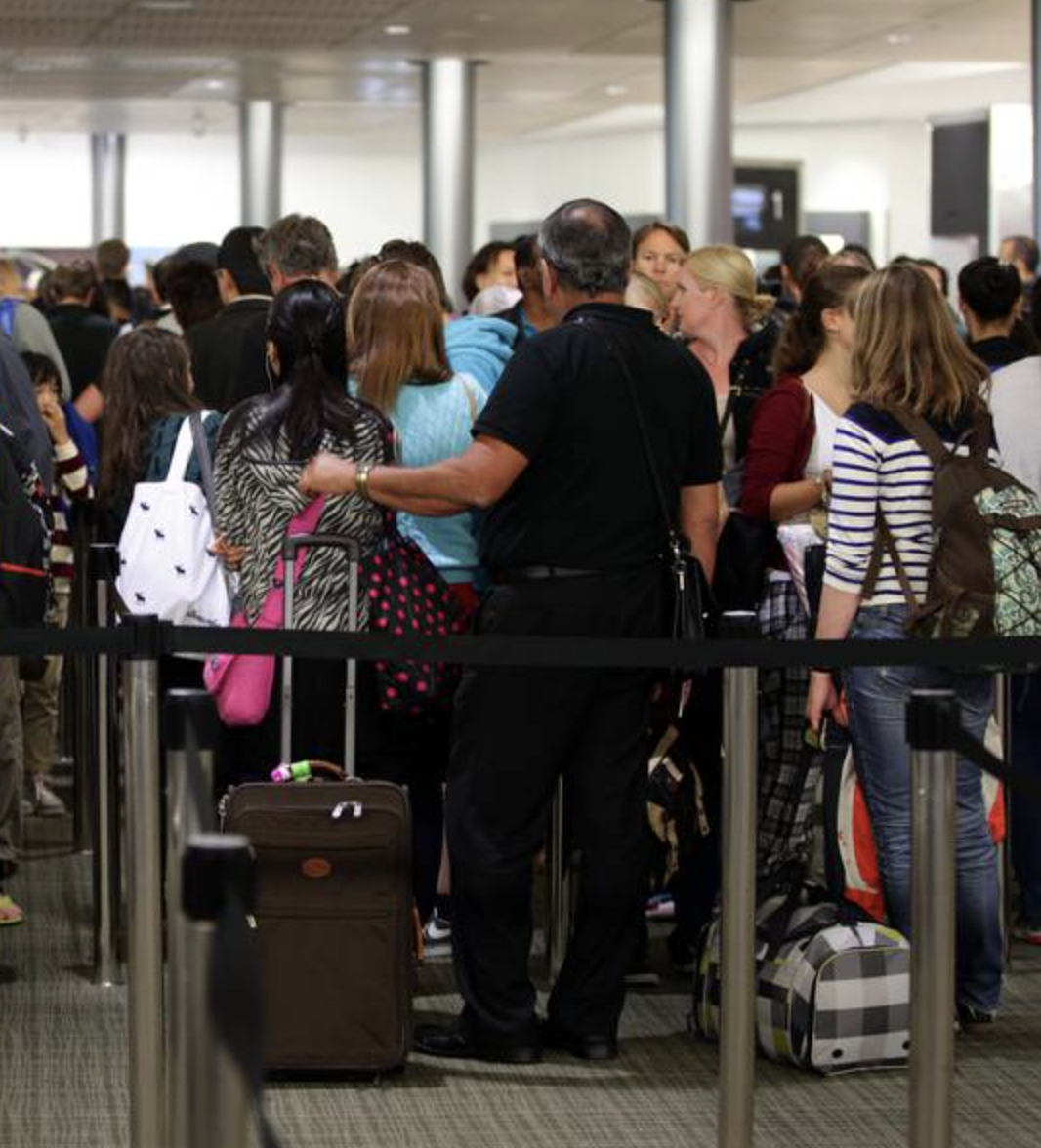
Annual net migration hit another record, but more Kiwis are leaving than returning.Annual net migration hit another record, but more Kiwis are leaving than returning.
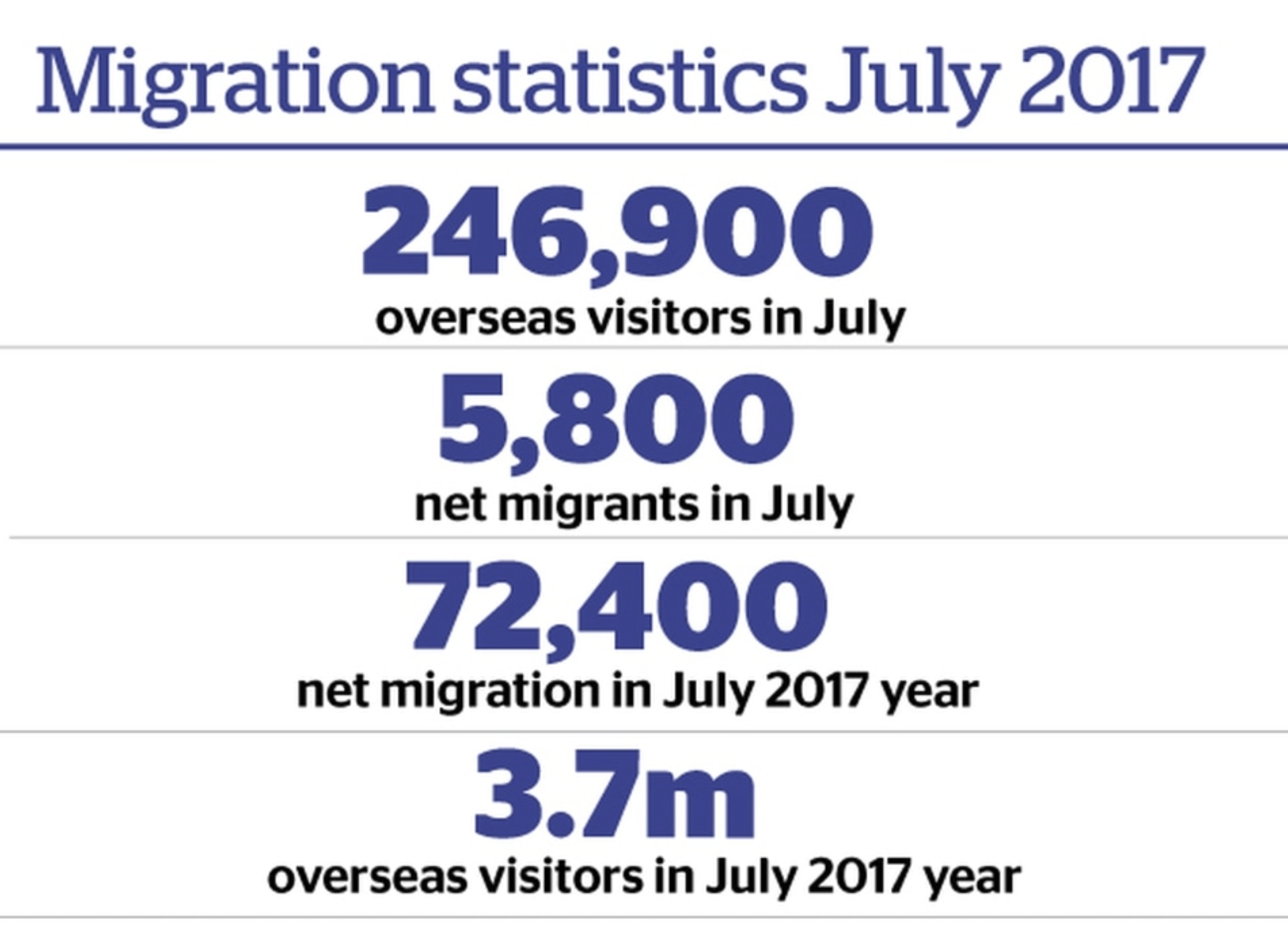
New Zealand annual net migration rose to a record in July, driven by foreign immigrants, with the biggest groups coming from Australia, the UK and ChinaAnnual net migration reached 72,400 in the year to July, up 3400 on the same period a year earlier, Statistics New Zealand said.
Three-quarters of the record 132,100 migrant arrivals were non-New Zealand citizens, with 1100 more New Zealanders leaving the country than returning in the latest year.
There has been a net migration gain of 72,400 non-New Zealand citizens in the past year to July.
New Zealand has been experiencing record levels of net migration in recent years, with rising immigration a key election issue as it strains the country's infrastructure and has been blamed for inflating property markets.
Chinese migration continued to be the largest on a net basis, with 9961 of the 72,400 net arrivals from China, while India was the second-largest source at 7444 net. However, Indian net migration was down 34 per cent from a year earlier, with a 32 per cent drop in annual student visas granted to Indian citizens.
Migration from the UK had the biggest increases on a net basis, up 53 per cent to 6750, with net South African migration also up 50 per cent to 4862.
The number of net migrants from Australia dropped to 469, from 1750 a year earlier.
China continued to be the biggest source of migrants on residence visas, rising 12.2 per cent to 3413 in the year to the end of July, ahead of the total residence visa gain of 7.2 per cent to 16,661. There was a 15.3 per cent increase in work visas granted in the year, to 45,397, while student visas dropped 9.9 per cent to 24,132 and NZ and Australian citizen arrivals rose 6.3 per cent to 38,740.
Short-term visitor arrivals, which include tourists, people visiting family and friends and people travelling for work, reached 3.7 million in the year ended May 31, up 9 per cent from a year earlier and a new annual record, Stats NZ said.
A record 1.9 million people came to New Zealand on holiday in the year, boosted by visitors from Australia, the US and the UK, with a spike from the UK in June during the Lions rugby tour.
New Zealand residents took a record 2.77 million overseas trips in the July 2017 year, up 11 per cent from the July 2016 year, with the biggest increases from people going to Australia, the US and China.
(Source: NZ Herald)
14/08/17 - Ben Mack: An immigrant's election advice to Kiwi politicians
Tick-tock. Tick-tock.
The countdown's begun to the September 23 generalelection. You've probably heard a thing or two about it. But don't worry: this column isn't about who you should vote for.
After all, there's a whole industry of people writing about that. Plus, I can't vote, because I'm not a citizen or permanent resident.
I'm not going to bellyache too much over the rules, but I still want to make my voice heard, somehow. So in lieu of being able to go to a polling place and cast my ballot (or whatever it is Kiwis do to vote (back in Oregon, it's entirely vote by mail. Bloody convenient), I'm going to offer some unfiltered advice for politicians on the campaign trail.
TALK ABOUT IMMIGRATION.
Your advisers might suggest otherwise, telling you something about "dividing the public" or some other such nonsense. Ignore them.
Talk more about immigration. Seriously, do. I can't speak for other immigrants, but for me my right to even exist in this great nation is my most important issue. When I finally can vote, you can bet your bottom dollar I'll be voting for whoever was looking out the most for me when I couldn't vote.
KEEP TALKING ABOUT IMMIGRATION
Although whatever you do, don't use language like "turn the tap down", here's looking at you, Labour. (You know who also said something similar? Trump). I'd also advise against talking about tightening the rules; that's you, National. It's the easiest way to lose our future votes.
TALK A BIT MORE ABOUT IMMIGRATION
But do it positively. More immigrants are coming here than ever before and with no signs of slowing down, and given many of us will become future voters, restricting immigration is a great way to tank your party in the future. Running the Beehive today, renting space in a 20 square metre garage in Thornbury tomorrow. Life comes at you fast.
I know I sound a bit like a broken record here but, Jacinda, do you want to smash National? Bill, do you want to stay on as PM? Then get up on stage or utilise an interview to discuss how great immigration is for NZ: How it's largely responsible for much of the country's economic growth, and is what continues to power the country to the point that, without us immigrants, New Zealand as a country would be very different to how most people know it.
It's the kind of thing Angela Merkel would say, even if not everyone agrees with her. But she was elected Chancellor in 2005, 2009 and 2013 - and it's looking increasingly likely she will be again this year, too.
Any guesses for what I'm going to say as my last piece of advice?
Quick Politics 101: You tighten immigration and less immigrants come to Aotearoa, meaning there's less people who can work. As a result, the economy suffers. This also means less money for important programmes like housing, mental health, infrastructure, et cetera.
Life gets worse for everyone. Oh, and you don't get re-elected. So no one wins in that scenario.
The numbers speak for themselves: in June, net migration for the year hit a new record high of 72,300. But, more importantly, 99,200 new non-NZ citizens arrived. That's 99,200 potential new voters. No matter how you slice it, that's a lot of people. You can't afford to not win our eventual vote.
Ok, so the odds of Bill English or Jacinda Ardern (or Winston Peters, or Marama Fox, or David Seymour, or Gareth Morgan, or any other leader of a political party in New Zealand) reading this themselves may be about the same as my beloved Portland Trail Blazers calling me up with an offer to play point guard for their upcoming NBA basketball season. But a person can dream, right?
And if, on the off chance, one of them does read this: get in touch. I'm more than happy to share some additional advice to help you win votes in the future. Spoiler: my tips are related to a topic that begins with the letter "i."
(Source: Ben Mack is a columnist for Lifestyle at The New Zealand Herald)
14/08/17 - Country split on National's controversial foreign workers plan
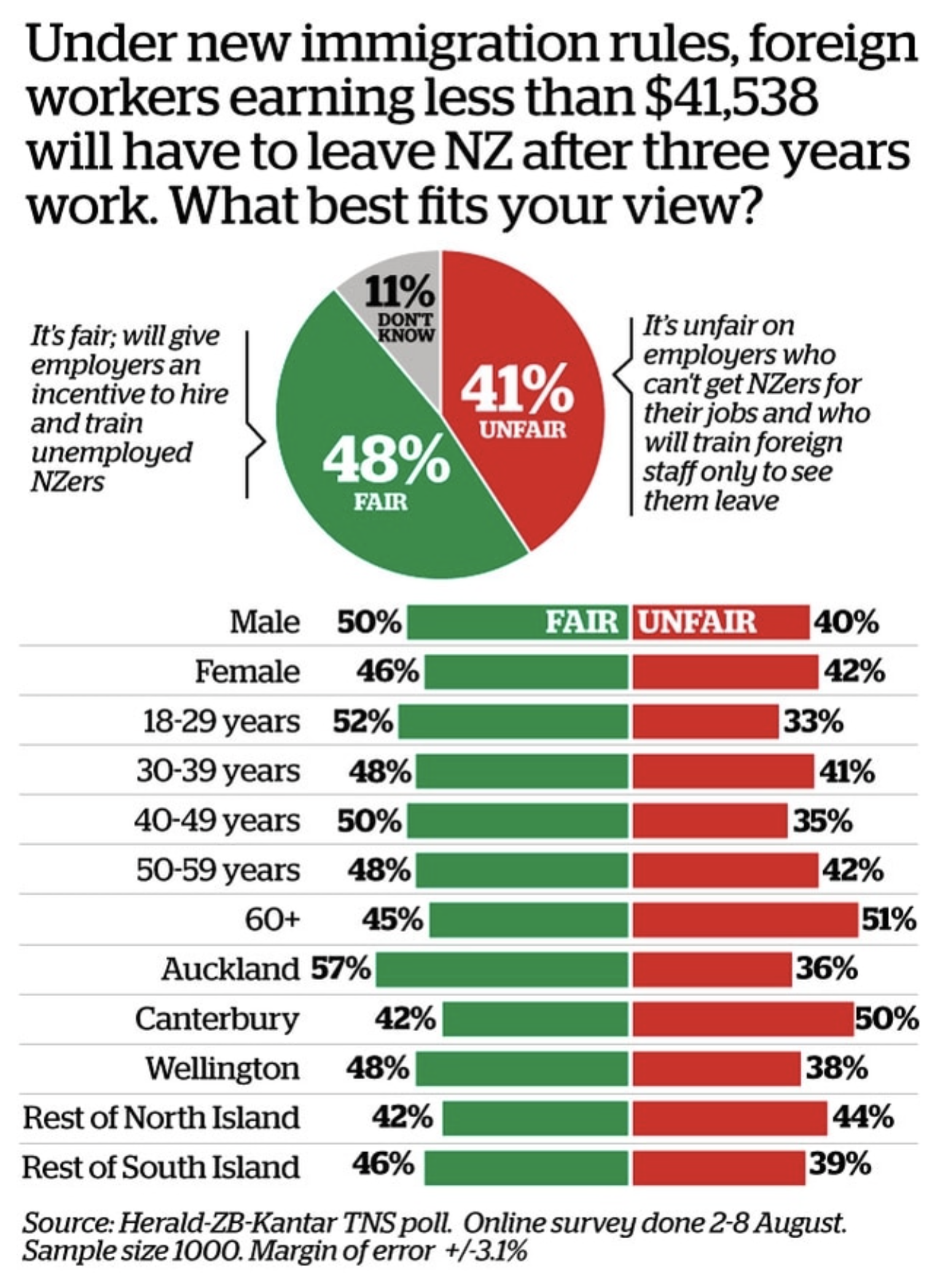
More people think National's controversial plan to make low-paid foreign workers leave the country after three years of work is fair than unfair, but not by much - 48 per cent to 41 per cent, in a Herald-ZB-Kantar TNS poll.
The Government announced the policy last month after putting it out for consultation in April, but many employers cried foul.
From August 28, migrants earning less than $41,538 a year will be considered a lower-skilled worker and will have to leave New Zealand for at least a year before reapplying for a work visa.
Respondents were given these options:
- It is unfair on employers who can't get New Zealanders for their jobs and who will train foreign staff only to see them leave; which got 41 per cent.
- It is fair and will give employers an incentive to hire and train unemployed New Zealanders; which got 48 per cent.
Only 11 per cent were not sure.
The most pronounced support for the limits on low-skilled migrants was from people from Auckland - 57 per cent believe it is fair while only 36 per cent think it is unfair.
In Wellington the policy was supported by 48 per cent of people, and opposed by 38 per cent.
The most pronounced opposition to the policy was from people in Canterbury, where many foreigners have helped with the earthquake rebuild: 50 per cent thought it was unfair and 42 per cent thought it was fair. More males than females thought it was fair, 50 per cent to 46 per cent.
And more young people support it, 52 per cent aged 18 to 19, while only 45 per cent aged 60 and over thought it was fair. It was part of a move to determine skill levels by remuneration bands.
Anyone earning over $73,299 will be considered high skilled, no matter what their occupation. Immigration Minister Michael Woodhouse said at the time it was a balanced and pragmatic approach.
(Source: NZ Herald)
04/08/17 - Essential Skills Framework
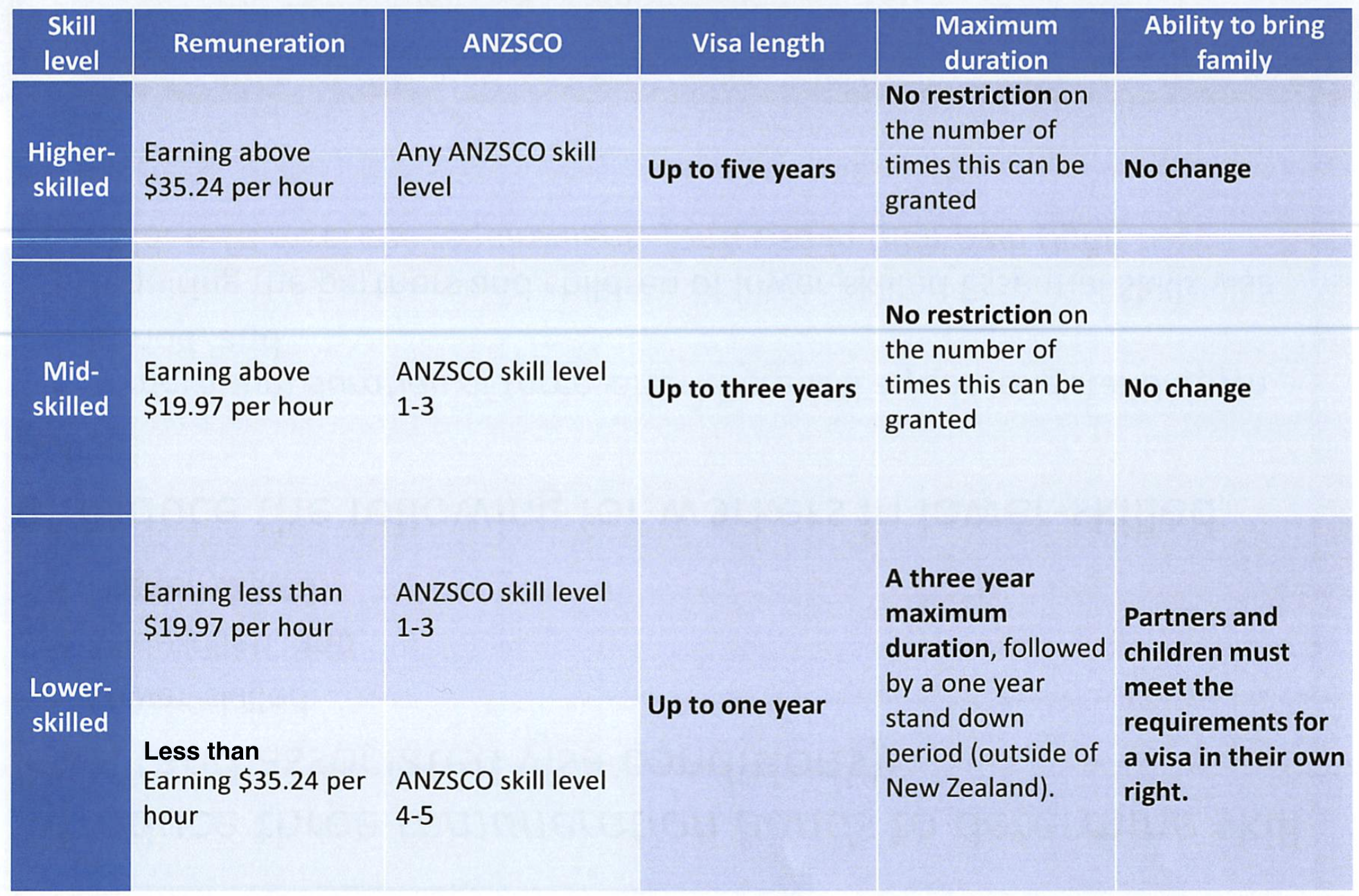
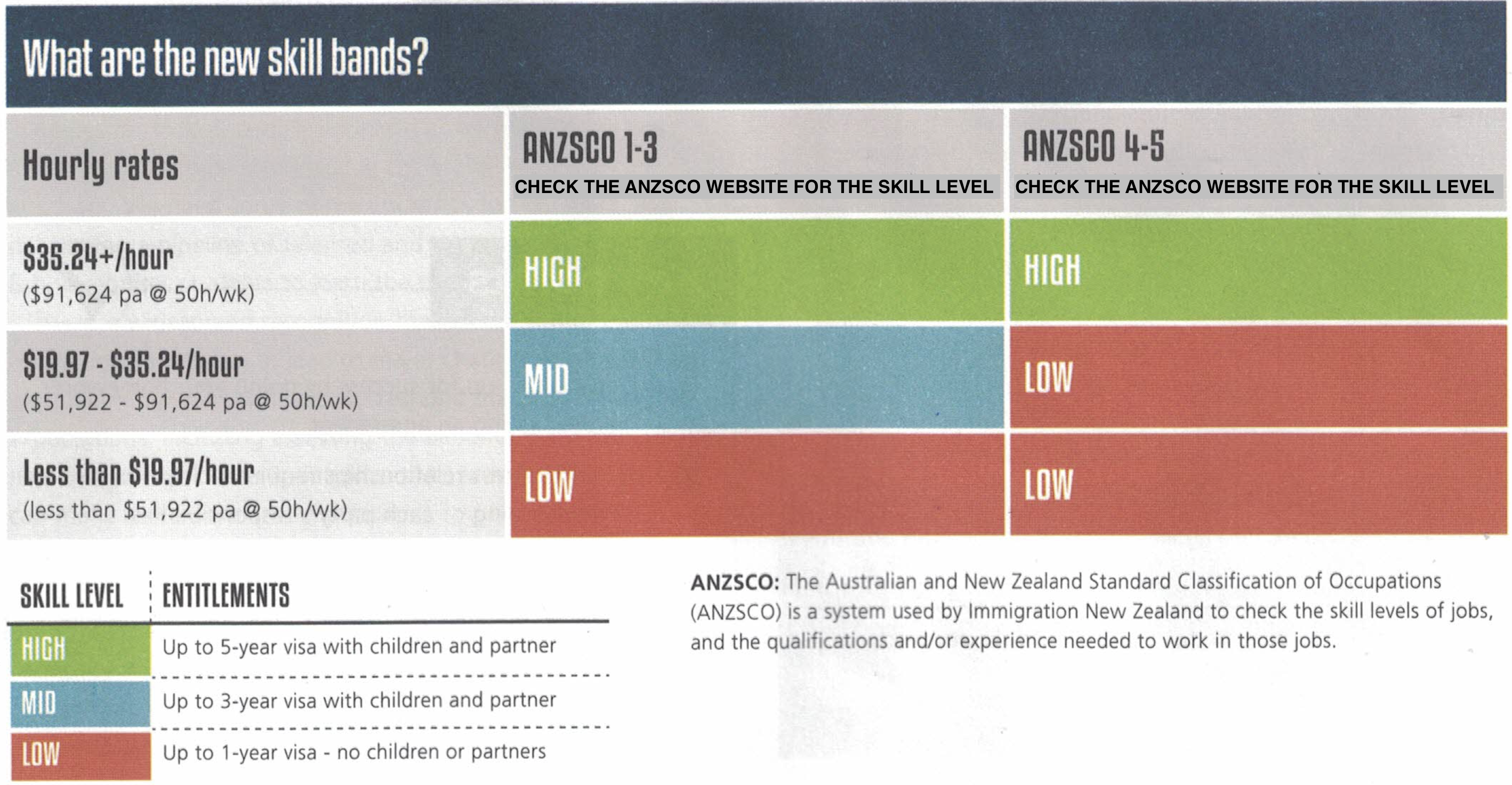
The following two tables provide you with answers based on the change in instructions by INZ on 28 August 2017;
- What will be the duration of my work visa?
- What do I have to earn?
- Can I bring my family members?
- What are the new skill bands?
04/08/17 - Immigration NZ staff investigated for corruption and fraud after visas issued to family, friends
Immigration New Zealand has received 208 allegations of staff fraud and corruption over the last five years.
Immigration New Zealand officials are being investigated for granting visas and residency to family and friends, a Herald investigation has found.
The agency confirmed that four have been dismissed and two had resigned while under investigation for conflicts of interest.
INZ received 208 allegations of staff fraud and corruption over the past five years, of which 48 were substantiated. Ten investigations are under way.
The Herald understands some visa officers had issued visas to family members and friends, including one senior official who had allegedly instructed staff to approve a residence visa for her partner.
Acting general manager Peter Elms said the agency received 53 allegations relating to staff fraud, corruption and dishonesty this year.
This was up from 23 allegations last year and 34 in the 2014/15 year.
"A total of 43 investigations have been completed with seven cases substantiated, the remaining 10 allegations are still being investigated," Elms said.
"Five of the seven substantiated cases had conflict of interest elements to them involving personal associations with clients, family and extended family members."
Elms said the allegations ranged from "comparatively minor breaches to very serious ones".
Of the substantiated allegations, four staff faced dismissals and others were issued warnings.Two resigned before relevant investigations were complete.
INZ staff must declare any conflicts of interest, including perceived or potential ones, upon joining and record those which arise during their employment in a Conflict of Interest Register.
"Failure to disclose or appropriately manage a conflict of interest could amount to serious misconduct and may result in disciplinary action up to and including dismissal," Elms added.
He said the agency took all allegations of conflicts of interest extremely seriously.
"Behaviour that undermines the integrity of the immigration system and reputation of the organisation will not be tolerated," Elms said.
"While substantiated cases of conflicts of interest are extremely rare, it is nonetheless very disappointing."
A former staff member, who spoke to the Herald on the condition of anonymity, said one of the cases involved a "relatively high-ranking officer" who allegedly instructed staff to grant a residence visa for a partner."[A visa officer] was told to keep quiet and just issue the residence visa label into her passport on the spot," the ex-staffer said.
"This person will be eligible for citizenship at some stage and this is just plain wrong."
The officer had also allegedly helped the partner obtain one or two work visas while an investigation into conflicts of interest were ongoing.
"Staff were told this was to allow for the processing of the residence application."
The ex-staffer said the agency had requested the names of all those who were aware of the case "in case of a leak".
When asked for comments on the case, an agency spokesman said: "INZ does not comment on individual employment matters so is unable to confirm any details on the case."
INZ employs 1900 staff worldwide, who make 800,000 visa decisions each year.
The agency said the issue of adhering to its conflict of interest policy and code of conduct is formally raised with staff at least twice a year during performance reviews.
(Source: NZ Herald, Lincoln Tan)
Covid 19 Notice
As the impact of the coronavirus continues to evolve, we face this unprecedented situation together. The pandemic is affecting all of us. At Terra Nova Consultancy Ltd we wish to reach out and update you on how we are addressing it. Our top priority is to protect the health and safety of our employees, clients, and our communities. Our focus on customer service remains at the center of everything we do, and we are fully committed to continue to serve you with our services, and striving to provide our services without interruption.Please listen and act upon the advise given by the Government, only in that way will we together be able to combat this challenge. And as always, stay healthy and keep safe.
TNC E-books
The Terra Nova e-book page contains publications in e-book and e-news format containing comments and reviews from Terra Nova Consultancy Ltd, and other contributors, that relate to a number of issues from immigration to operating a business.
Some of the Terra Nova e-books e-book and the Terra Nova e-news issues we believe may be quite helpful for prospective immigrants.
Check back regularly to find new editions of our Terra Nova e-book and Terra Nova e-news range.
Quick Links
Translate this site
Contact Details
Terra Nova Consultancy Ltd
165A Old Railway Road
Kumeu
New Zealand
Please arrange visit by appointment.
Mobile: +64 275 706 540
Postal Address:
as above
Licensed Immigration Adviser
Johannes Petrus (Peter) Hubertus Cornelis Hendrikx

License number: 200800214
Is your Immigration Adviser
licenced by the NZ Government?
Click here for details www.iaa.govt.nz