
.|

NEWS
A variety of immigration, business and general news articles taken from New Zealand newspapers, websites and other sources (sources are mentioned at the bottom of each article) and selected by Terra Nova Consultancy Ltd. It may assist the reader being more or less up-to-date what is happening in Aotearoa, "the Land of the Long White Cloud". Happy reading, enjoy ... and if you have any questions on these updates - please contact us...
Newest article always on top.
27/02/18 - Simon Bridges is National Party's new leader revealed
Simon Bridges is National's new leader, while Paula Bennett has retained the deputy's role. The pair emerged from today's caucus vote with wide grins after sealing the leadership.
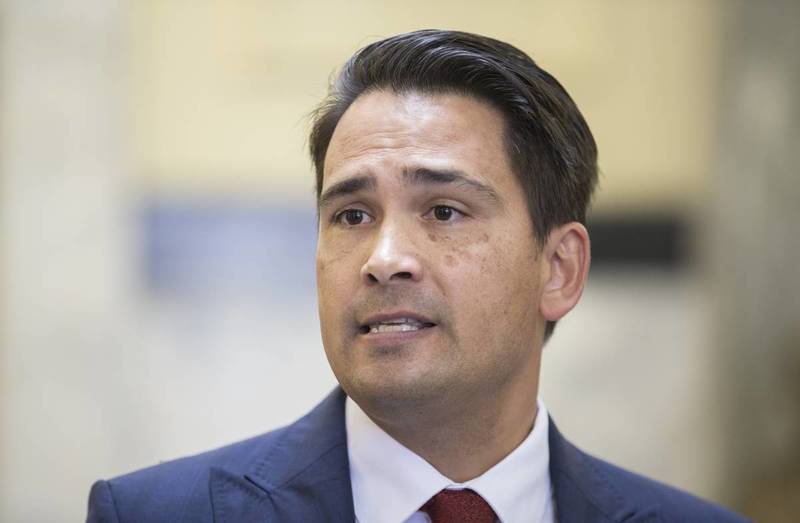 Simon Bridges has the accent of New Zealand's future. Get used to it
Bridges said it was an "enormous privilege" to replace Bill English.
"My focus as leader will be ensuring we build on those policies to improve the lives of New Zealanders," he said.
"Our caucus has an incredible depth of talent and abundant energy which is why we continue to enjoy so much support. New Zealanders believe in our vision for New Zealand and in our team.
"My job as leader will be to hold the Jacinda Ardern-Winston Peters coalition to account.
Bridges replaces Bill English, who resigned on February 13. He will leave Parliament this week, after two stints as National's leader and 10 months as prime minister after Sir John Key quit.
Judith Collins was the first to announce she would run for leader, followed by Amy Adams, Simon Bridges, Mark Mitchell and Steven Joyce.
A quick look at Simon Bridges – aged 41
- POLITICS: MP for Tauranga, first elected in 2008 replacing National MP Bob Clarkson. Former Minister of Economic Development, Transport, Energy, Labour, Communications and former Leader of the House. Joined Young Nationals aged 16. Stood a deputy leader in 2016 against Paula Bennett.
- WORK: Previously Crown Prosecutor in Tauranga.
- FAMILY: Raised in Te Atatu, West Auckland, the youngest of six children. Father was a Baptist minister, mother was a primary school teacher. Ngati Maniopoto. Met his wife, Natalie, at Oxford University. Three children, two boys and a daughter who was born in December.
- EDUCATION: Former head boy at Rutherford High, where former Labour minister Chris Carter was one of his teachers. BA and LLB (Hons) from Auckland University, Bachelor of Civil Law from Oxford University.
- VOTING: Voted against same sex marriage but says now the law is working well and would not change it. Voted against first reading of euthanasia bill.
- OTHER: Likes drumming. Tamaki MP Simon O’Connor is his brother-in-law.
Simon Bridges has said:
- “My focus as Leader will be ensuring we build on those policies to improve the lives of New Zealanders.
- “Our caucus has an incredible depth of talent and abundant energy which is why we continue to enjoy so much support. New Zealanders believe in our vision for New Zealand and in our team.
- “My job as Leader will be to hold the Jacinda Ardern-Winston Peters coalition to account.
- “Their Government is big on lofty intentions, but struggling to turn that into real gains for New Zealanders.
- “That’s why we will continue to present an ambitious and strong alternative Government, heading into 2020."
The first challenge for Bridges will be to unify the caucus after the intense two-weeks leadership contest.
That will be done partly through a re-allocation of roles in a reshuffle, which can be expected as early s this week.
All leadership contenders can expect to have prominent roles in the new lineup.
The biggest issue will be who gets finance, held for the past year by Steven Joyce.
Bridges will be straight into their work - appearing in Parliament at 2pm today to lead National's questions to Prime Minister Jacinda Ardern.
Performance in the House is not considered the most important part of the leader's role but it is crucial to maintaining morale in the party.
After 27 years in Parliament, Bill English will deliver his valedictory address on Thursday.
English took over the leadership for a second time, after the sudden resignation in late 2016 of successful Prime Minister John Key who won three consecutive elections.
National was the highest polling party at the 2017 election – 44.4 per cent compared to Labour's 36.9 per cent – but failed to get a fourth term because New Zealand First elected to form a coalition with Labour.
The National caucus met today behind closed doors to select the new leader, who required the support of at least 29 of the party's 56 MPs. The actual voting numbers are not revealed to caucus.
Each candidate presented a final five-minute pitch to their colleagues at today's meeting.
End of an era
Today's outcome spells the end of the John Key and Bill English era – an era of unprecedented high popularity for National, including three terms in power from 2008-2017.
Bill English arrived at Parliament earlier today - for his last few hours in the job - keeping tight-lipped about the process to replace him.
He plans to pack up his office, go to a temporary office and be out of Parliament by the end of the week.
He would not make a prediction or say who he was voting for. But he said the new leader needed to be "patient".
Caucus had handled the process of selecting a new leader well, English said.
"They have been civil, they have been respectful, they have gone about it competently and that is a great start for a new leader."
(Source: NZ Herald,
23/02/18 - Record-breaking Kiwi summer heatwave turns Auckland tropical for a week
Not only was the 2017/2018 summer New Zealand's hottest on record, a meteorologist says a particularly tropical week in Auckland was comparable to living in Fiji.
Niwa's Ben Noll said Auckland endured climate conditions similar to Fiji or New Caledonia for a near five-day period from February 5.
That was when the dew point, a measure of both humidity and temperature, for Auckland failed to drop below 19 degrees for 115 hours.
"It was as if you were transported 5 degrees or 10 degrees north in latitude for a period of time."
Overall, it's been the country's hottest summer on record. And there are still five days to go.
Data released on Friday from climate agency Niwa shows temperatures are running 2.3 degrees Celsius above average.
You have to go back more than 80 years to 1934/1935 to find our next hottest summer - which was still half a degree colder than what Kiwis are experiencing now.
And there's still five days left in summer for this year's record-breaking average to push higher.
Well-above average sea temperatures around New Zealand have been credited - or blamed - for boosting summer highs.
Noll said since November last year there have been "three distinct peaks when sea surface temperatures were between 2 to 4 degrees above average".
"Mid-December, late January and mid-late February."
In some areas sea temperatures spiked at 6 to 7C above average.
"This represented some of the largest ocean temperature anomalies anywhere in the world over the last several months."
With this season's balmy to uncomfortably hot temperatures have come extreme weather events.
Warmer seas have allowed marauding subtropical cyclones like Gita to barrel south onto New Zealand, endangering lives and damaging land and property.
Auckland even turned tropical for a five day period starting February 5, Noll says. Auckland had more in common with Fiji or New Caledonia.
OUR HOTTEST SUMMER
- 108 places across New Zealand recorded their hottest summer on record, 21 their 2nd hottest and 8 their 3rd hottest.
- In Alexandra on January 30 the temperature reached 38.7 degrees. On the same day Clyde got to 37.6, Middlemarch 37.4 and Cheviot 37.3 – together these comprise the hottest temperatures of summer.
- Wellington has had 17 days above 25 degrees this summer – their average is two.
- Auckland usually has 29 summer days above 25 degrees, this year there have been 47 – the highest since records began at Auckland Airport in 1966.
- Christchurch had temperature highs of 33, 32 and 35 degrees in the months of December, January and February 2018 with an average temperature of 23 degrees. About 261mm of rainfall was recorded from December to date.
- Invercargill recorded three consecutive days over 30 degrees in January. It's never done that for two days in a row, let alone three.
- Cromwell has topped 25 degrees for 56 days – normal is 35 days.
- Auckland's dew point temperatures (humidity) failed to drop below 19 degrees for five days in February making for a rare 115-hour period of very high humidity.
- Wellington copped a dew point temperature of 22 degrees at 6pm on February 11, the highest dew point on record for the city.
- Mahia, Appleby and Waipara West have had their wettest summers on record.
(Source: Stuff)
25/02/18 - NZ's skills shortage may have contributed to illegal workers
There are suggestions the extent of our shortage in skilled labourers could have opened up space for illegal workers to infiltrate the construction sector.
It comes after nearly 200 illegal workers from Malaysia were deported or stopped at the border during an Immigration swoop.
Many worked under the table as third-tier subcontractors.
The Specialist Trade Contractors Association says law-abiding companies can't compete with the prices under-the-table workers might offer.
And president Graham Burke says they're already struggling to get the staff numbers they need and making it easier for legit companies to bring labour into the country could minimise issues around illegal workers
"It makes me quite angry actually because the vast majority of the businesses in the sector are law-abiding, they are playing plenty of tax, they are training young New Zealanders.
"If Immigration NZ was able to make the process a little bit simpler for good employers it may mean that the market wouldn't encourage this kind of behaviour."
(Source: Newstalk ZB Staff)
24/02/18 - Raids on Auckland construction sites stops nearly 200 illegal workers
EXCLUSIVE: Immigration New Zealand investigation targets 10 companies, finds 15 immigration fraudsters previously deported.
Nearly 200 illegal Malaysian workers were deported - or stopped at the border - following a six month investigation into Auckland's construction industry.
Operation Spectrum also uncovered a weakness in border security where 15 people previously deported or fled from New Zealand, were able to return under new identities.
Many of these immigration fraudsters registered companies in New Zealand, then recruited other unlawful workers as plasterers, painters, tilers or carpenters. They worked as third-tier subcontractors, below the radar of developers and site managers.
There was little evidence of workers living in poor conditions, or being exploited against their will. Most were paid just $20 to $40 an hour in cash - paying no tax - so those running the underground crews were able to win contracts by undercutting the prices of legitimate competitors.
"It was common to hear 'we got paid every Thursday by a man in a black Audi'," said Alistair Murray, who manages investigations and compliance for Immigration New Zealand.
"We are talking significant cash flow, hundreds of thousands of dollars.
READ MORE: Tradies say NZ's skills shortage lead to illegal immigrants
"So Kiwis are being cut out of jobs. Legitimate Kiwi businesses trying to contract in that market, can't compete with those rates. It's not a level playing field."
Immigration New Zealand investigators drew a target list of 10 companies to disrupt the flow of illegal workers from Malaysia, who were responding to advertisements on social media.
Staff raided construction sites around Auckland and detained and deported 54 people.
On one occasion, at least 20 illegal workers fled and scattered through the streets of Mt Wellington.
"They just scarpered, disappeared when we turned up," said Murray.
"Even on the most simple of sites, it was a massive exercise to do a floor-by-floor sweep with two people blocking each exit. We'd find people hiding in fire exits, stairwells, ceiling cavities.
"Or sometimes they were in the middle of plastering a wall and we'd tap them on the shoulder to say: 'You've been here unlawfully for 10 years, time to go home'."
Another 36 people fled the country before they were caught, while 15 who had visas to live in New Zealand - but not to work - were served with deportation liability notices.
On average, those 105 people had each lived here unlawfully for 5 years.
One had been here for two decades.
"They're living here, enjoying the benefits of New Zealand," said Murray.
"Cutting legitimate businesses out of work. And not one of them paying tax."
Another 85 would-be illegal workers were stopped at the New Zealand border, or sometimes before they even stepped foot on the plane to carry them here.
In total, 190 people were stopped over the course of a six-month period.
Out of those, Operation Spectrum uncovered 15 who had previously been deported, or fled New Zealand before they were caught, but returned under a new identity.
"The ability of someone to be deported, change identity, and be back quickly is a concern," said Murray.
"Because we don't know who is here."
Just two went on to obtain permanent residency; the rest were deported again.
Murray said improved collection of biometric data, such as fingerprints, facial recognition software and database checks by Immigration NZ staff means more dual identities are much more likely to be picked up.
One of the pair who obtained permanent residency under his new identity has now pleaded guilty to immigration fraud.
Adam Gan Bin Abdullah, 39, appeared in the Manukau District Court this week where he narrowly avoided going to prison.
Abdullah, a builder by trade, was deported from New Zealand in 2012 under his previous name of Meng Kuang Gan.
He changed his name in Malaysia after marrying a Muslim woman, as is the custom, and returned to New Zealand the following year.
Abdullah repeatedly failed to declare his previous name or deportation, eventually obtaining permanent residency here until being caught in Operation Spectrum.
This is likely to be revoked and led to a second deportation, his lawyer Michael Kan told the court.
By a "fine margin", Judge John Bergseng agreed with Kan's submissions that Abdullah should be sentenced to home detention.
He will serve 10 months at an address in Flat Bush.
"Truthful declarations are the cornerstone of the New Zealand immigration system. Your offending directly challenged this," said Judge Bergseng.
"You had a deliberate plan to deceive. This was clearly premeditated, fraudulent and repeated. Having been successful once, you thought you'd get away with it again."
(Source: Jarad Savage, NZ Herald )
09/02/18 - Application lodged for 174 foreign worker visas for Park Hyatt Hotel
Immigration NZ has only just received an application for foreign workers from a local subsidiary of a Beijing-based property developer, which has publicly said it wants up to 200 Chinese workers to help build a high-end Auckland hotel.
In response to Radio New Zealand queries yesterday, developer Fu Wah said it intended to bring in the foreign workers because of a skills shortage in the construction sector.
Fu Wah wants the workers to help finish the $200 million-plus Park Hyatt Hotel on Auckland's waterfront, expected to be finished by March next year.
Following media reports, Immigration Minister Iain Lees-Galloway sought clarity from Immigration NZ that the application for work visas was legitimate and in an area of genuine need.
Today he released an aide memoir from the Ministry of Business, Innovation and Employment showing that Fu Wah had only informed Immigration NZ of its intentions yesterday.
"On 8 February, 2018, Fu Wah New Zealand's lawyer provided Immigration NZ with a copy of a cover letter for an Approval in Principle application, which they plan on submitting on behalf of their client in the near future," the memoir said.
The cover letter stated that Fu Wah New Zealand has set up a joint venture company with LBY New Zealand Construction, a subsidiary of LBY China. The company wants to bring in 174 experienced workers from China to work with about 100 local workers for the "fit-out" phase of the project.
But the letter does not specify the dates for when the workers will be needed.
It is understood Immigration NZ received the formal application this morning.
The aide memoir notes that the application will be processed in consultation with Work and Income, industry training organisations and the Council of Trade Unions.
Fu Wah New Zealand has supported visa applications for 37 other people since March 2015, mostly for general business visas. These allow visitors to be in New Zealand for up to three months for business meetings and negotiations, but they are not considered to be in employment in New Zealand.
Yesterday Lees-Galloway conceded there was a shortage of skills in the construction sector.
"The previous government failed to invest in the skills that New Zealanders need to participate in that sector."
Government policies including having a year of fees-free post-secondary education and the He Poutama Rangatahi employment scheme - $13 million to get 2000 young people into work in the regions - would help upskill the labour market, he said.
The Government also plans to introduce the KiwiBuild Visa to help build 100,000 affordable homes in 10 years. The visa would bring in up to 1500 foreign workers, conditional on taking on a local apprentice for each foreign worker.
"Where there are genuine skills shortages, and employers need to get workers and to use immigration to get workers, that's where we'll make sure the system works for them," Lees-Galloway said.
(Source NZ Herald, Derek Chang)
07/02/18 - Unemployment hits nine-year low
Unemployment has fallen to its lowest level in nine years.
The seasonally adjusted unemployment rate fell to 4.5 percent in the December 2017 quarter, down from 4.6 percent last quarter, Statistics NZ said.
The rate still sits higher than New Zealand's lowest-ever unemployment level of 3.3 percent, recorded just before the global financial crisis.
The last time the rate was this low was in December 2008, when it was 4.4 percent.
Westpac senior economist Michael Gordon said the December result was stronger than expected.
"The June quarter survey showed zero employment growth and a drop in the participation rate, followed by a surge in both measures in the September quarter," he said.
"The continued rise in employment in the December quarter - by more than we expected - tips the evidence more in favour of the June quarter survey being an understatement."
However, the under-utilisation rate - which includes people who are employed but may be looking for more hours - was 12.1 percent, or 340,000 people.
Labour market and household statistics senior manager Jason Attewell said that rate was just as important as the unemployment rate.
"Underutilisation is a broader measure than unemployment alone," he said.
"For example, [it includes] a university student looking for a job in anticipation of graduating, or a parent who has recently returned to the workforce looking to work more days."
While unemployment among men was steady, the rate among women fell from 5.3 percent to 5.0 percent.
The labour cost index - the amount wages and salaries increased overall - rose 1.8 percent.
Statistics NZ said that increase was partly driven by the pay equity settlement for care workers, which was passed into law last year.
The Reserve Bank reviews its official cash rate tomorrow, but Mr Gordon said today's employment numbers would not be a shock.
"The fall in the unemployment rate is in line with their November MPS projections, and the lack of a pickup in wage growth is in line with the RBNZ's concerns about a new low-inflation era," he said.
The OCR was expected to stay on hold all year at a record-low 1.75 percent.
(Source RNZ)
07/02/18 - JP accuses Immigration NZ of employing 'spies' in China who deny visas over Falun Gong links
A Justice of the Peace is accusing Immigration New Zealand of employing Chinese "spies" in its China offices.
Poutama Tsoi, who has been helping China nationals with their immigration matters, says applicants linked to Falun Gong - a banned spiritual group in China - are being denied tourist visas to enter New Zealand.
"We are not talking about just members of Falun Gong but also their relatives, and they get declined even if they list an agent or a family member in New Zealand who is linked to Falun Gong," Tsoi said.
"INZ staff are employed through a central government agency, it is unwittingly employing spies who abide by China rules rather than New Zealand's."
The agency confirmed that all Chinese nationals working for INZ were employed through Chinese Government agencies, but that it does its own advertising, recruitment and selection of staff.
INZ has 115 Chinese nationals working in its Beijing office and 90 in its Shanghai branch.
Tsoi currently has four cases pending - one of whom has been fighting since 2013 to get visitor visas for relatives from China to visit them in New Zealand.
But INZ area manager Marcelle Foley rejected the claim that people linked with Falun Gong were being denied visas.
"INZ does not ask applicants about their religious or personal beliefs and in any event this has no bearing on whether or not a visa is granted, as long as we are satisfied that the applicant intends a temporary stay for tourism purposes and that they are of good character and meet health requirements," Foley said.
"The onus is on the applicant to satisfy INZ that they meet these requirements."
Foley said the China visitor market was one of New Zealand's largest and most valuable, and about 97 per cent of visa applicants get approved.
Last year 410,130 Chinese visitor applications were processed offshore, mainly in China, and 12,320 were declined.
Over the same period, 25,499 applications were processed in New Zealand and 402 failed to get approved.
"A visitor visa is generally granted for tourism purposes and enables an initial temporary visit for Chinese applicants of up to three months," Foley said.
"(It) enables people to visit New Zealand for a holiday or to visit friends and family."
Flatbush businesswoman and Falun Gong practitioner Jasmine Wang, 40, said none of her relatives have been able to get visas to visit New Zealand — including an uncle, aunt and a cousin.
Her 65-year-old mother, Fang Ling Wang, was granted refugee status in New Zealand because of her close links to the movement.
In the letter declining her uncle's application, INZ said: "We are unable to be satisfied that you have provided sufficient evidence to demonstrate that you are a bona fide applicant who genuinely intends a temporary stay in NZ for a lawful purpose."
Wang believed her uncle had met all requirements for a visitor visa.
"How do you prove intent and being bona fide when INZ already have this preconceived idea that they intend to overstay just because they have relatives who are Falun Gong members," Wang added.
(Source NZHerald, Lincoln Tan)
30/01/18 - Tourism boom set to continue but worries about shortage of Kiwi workers
A major study of the tourism industry shows businesses are confident the boom will continue but remain worried about infrastructure gaps and a shortage of Kiwis to work in the sector.
The survey of more than 350 businesses for Tourism Industry Aotearoa finds 62 per cent of businesses expect their results will improve during the next year in a sector that is the country's top foreign exchange earner.
In the year ended March 2017 international arrivals were up 8.9 per cent to more 3.5 million, the fifth successive year of growth. Overall visitor spend is rising at a slower rate, up 1.9 per cent to $35.9 billion. And while domestic spend was up 4 per cent to $21.4b, international spending weakened 0.9 per cent to $14.5b in the period studied by the Wellington Institute of Technology.
In spite of a change in marketing strategy to attract visitors at off-peak times and away from top tourist destinations, there had been no significant progress since 2014 on increasing the visitor spend in the regions or on altering international visitors' seasonal travel patterns.
And visitor experience data shows there are slipping levels of satisfaction although they remain very high. This country met or exceeded expectations among 95 per cent of visitors in 2015 but this had slipped to 93.4 per cent last year.
The report finds that while infrastructure rates highly or air and tourist service infrastructure — 15th and 19th respectively — port and ground infrastructure is well down the World Economic Forum ranking in 50th place.
''Survey responses not only suggest the impact of inadequate infrastructure constrains growth but it also has a negative effect on the visitor experience,'' said the report authored by tourism lecturer Jamie Smiler.
''International visitors have many destination options and they want to move easily through a destination.''
Infrastructure was of strategic importance for New Zealand's global competitiveness and a theme of comments from respondents suggested that more central Government funding should come from GST collected from visitors with budget allocations based on tourism's contribution to the economy and border taxes.
The Auckland Council targeted rate on commercial accommodation providers - which is used to partly fund tourism promotion - was seen as offering very little value to the industry.
(Source NZHerald, Grant Bradley)
28/01/18 - Big drop in Indian student visa applications
The number of study visa applications lodged with Immigration New Zealand in India plummeted last year, as did the proportion of failed applications, Immigration figures show.
The agency's India staff considered 9429 study visa applications in 2017, down from 16,380 in 2016 and 25,977 in 2015.
They approved 6425 of the Indian applications and declined 3004, for a decline rate of 32 percent, down from more than 50 percent in 2015 and 2016.
The improvement follows the introduction of tougher rules prompted by a surge of fraudulent applications.
In the Philippines, 1148 applicants were approved last year and 397 or 26 percent were refused.
Immigration turned down 368 applications from applicants in Nepal, 52 percent of the total it received, while in Sri Lanka it approved 552 applications and refused 257 or 32 percent.
In Vietnam, 960 applications were approved, and 296 or 24 percent were refused.
In China, 7327 applications were approved and 542 declined for a decline rate of 7 percent.
Students from countries with offshore visa decline rates of more than 20 percent must meet tougher English language requirements in order to gain a study visa.
(Source RNZeducation, John Gerritsen)
12/12/17 - Skilled Migrant and Essential Skills policy – Changes to remuneration thresholds
Remuneration thresholds in Skilled Migrant and Essential Skills policies will be increasing on 15 January 2018.
29/11/17 - Indians bearing brunt of immigration crackdown, advisors say
Indians bearing brunt of immigration crackdown, advisors say
An Indian migrant - twice denied a work visa - believes he's being unfairly targeted because of his nationality.
Immigration advisers say a crackdown on visas is under way, with official figures showing a sharp increase in the number of work visas being rejected for Indian applicants over the last four months.
Immigration New Zealand figures released to the Immigration Advisers Authority under the Official Information Act showed the percentage of post-study employer-assisted work visas that had been rejected increased from 4 percent to 16 per cent in the 16 months between January 2016 and May 2017.
Indian nationals are the worst affected in recent months, Wellington immigration lawyer and Association of Migration and Investment's policy director Richard Small said.
"Indian requesters for visas who do not have current visas - they're being refused at record levels. For some groups of migrants it is a very desperate landscape."
Indian community leader Sunny Kaushal, from Auckland, said he had been approached by five Indian migrants in the last two weeks over the issue.
"If the government does not review this soon we will be in trouble. There are not enough New Zealanders to take up the jobs that these immigrants are filling."
Mukesh Kumar, from Rotorua, said Immigration New Zealand told him his job as a dairy manager did not match his qualifications, despite having a Graduate Diploma in Business.
He is now appealing his case, but said he had several friends in similar situations.
"They are playing with our feelings, they are playing with our money. When they needed money ... they called us to come and study here. Now they don't need us they are just kicking us out."
The 25-year-old moved from India in 2015 to study business at Waiariki Institute of Technology. He found a part-time job in a local dairy and when he completed his Level 7 Graduate Diploma in Applied Business Studies, he took over as the dairy's manager.
In July, his boss helped him apply for an employer-assisted work visa, but a dodgy immigration consultant failed to process the paperwork in time and it was rejected.
Despite his new lawyer being confident he'd get one, his second application was denied too.
Unable to work, Mr Kumar said he was relying on the charity of his employer while he waits to hear if he can stay in New Zealand.
He has spent close to $40,000 applying for visas and paying for lawyers' fees since 2015, and said his latest troubles had cost him $7000.
Immigration New Zealand said there had been no change in the way it assessed visa applications and last year just over 5 percent of work visa applications from Indian nationals were declined.
The rejection figures for the first four months of this year was not a long enough period to justify a trend, a spokesperson said.
However, Mr Small from the Immigration Advisers Authority said there was a wide gap between what Immigration New Zealand was saying and what immigrants and their advisers were seeing.
Watch video on www.youtube.com, or enable JavaScript if it is disabled in your browser.
http://www.youtube.com/watch?v=T74wO74abFs" target="_blank"
(Source: RNZ, Anusha Bradley)
Covid 19 Notice
As the impact of the coronavirus continues to evolve, we face this unprecedented situation together. The pandemic is affecting all of us. At Terra Nova Consultancy Ltd we wish to reach out and update you on how we are addressing it. Our top priority is to protect the health and safety of our employees, clients, and our communities. Our focus on customer service remains at the center of everything we do, and we are fully committed to continue to serve you with our services, and striving to provide our services without interruption.Please listen and act upon the advise given by the Government, only in that way will we together be able to combat this challenge. And as always, stay healthy and keep safe.
TNC E-books
The Terra Nova e-book page contains publications in e-book and e-news format containing comments and reviews from Terra Nova Consultancy Ltd, and other contributors, that relate to a number of issues from immigration to operating a business.
Some of the Terra Nova e-books e-book and the Terra Nova e-news issues we believe may be quite helpful for prospective immigrants.
Check back regularly to find new editions of our Terra Nova e-book and Terra Nova e-news range.
Quick Links
Translate this site
Contact Details
Terra Nova Consultancy Ltd
165A Old Railway Road
Kumeu
New Zealand
Please arrange visit by appointment.
Mobile: +64 275 706 540
Postal Address:
as above
Licensed Immigration Adviser
Johannes Petrus (Peter) Hubertus Cornelis Hendrikx

License number: 200800214
Is your Immigration Adviser
licenced by the NZ Government?
Click here for details www.iaa.govt.nz