
.|

NEWS
A variety of immigration, business and general news articles taken from New Zealand newspapers, websites and other sources (sources are mentioned at the bottom of each article) and selected by Terra Nova Consultancy Ltd. It may assist the reader being more or less up-to-date what is happening in Aotearoa, "the Land of the Long White Cloud". Happy reading, enjoy ... and if you have any questions on these updates - please contact us...
Newest article always on top.
27/07/17 - Remuneration bands: Questions and answers
Why are we introducing remuneration bands and what will they be?Why are we introducing remuneration bands and what will they be?
Remuneration is an excellent proxy for skills and the introduction of remuneration bands will complement the qualifications and occupation framework (ANZSCO). The bands are:-
- Higher-skilled – Any Essential Skills visa holder earning above 1.5 times the New Zealand median full-time income (currently $73,299 per year), regardless of their occupation
- Mid-skilled – Any Essential Skills visa holder earning above 85 per cent of the New Zealand median full-time income (currently $41,538 per year), in an occupation classified as ANZSCO Level 1-3, and
- Lower-skilled – Any Essential Skills visa holder earning below the mid-skilled remuneration threshold.
How many lower-skilled Essential Skills visa holders will be affected by the proposals?
Setting the mid-skilled remuneration threshold at 85% of the New Zealand median wage would mean that between 9,700 and 11,800 Essential Skills visa holders at ANZSCO levels 1-3 would be classified as lower-skilled (totalling between 38% and 46% of Essential Skills visa holders at ANZSCO levels 1-3). As at 13 May 2017 there were 11,214 Essential Skills visa holders in occupations at skill levels 4 and 5. While a small number may earn above the higher-skilled threshold we expect the majority to remain lower-skilled under the new definition.
How will employers be able to source the labour they need under the proposals?
Immigration policy is premised on a New Zealanders first approach and employers are required to ensure they are doing all they can to train and employ New Zealanders. However, these changes are not designed to reduce the number of migrants coming in on temporary work visas. Where there are genuine skills shortages, employers will still be able to recruit temporary migrant workers, as long as they can demonstrate there are not New Zealanders available to do the job.
Why has three years been chosen as the maximum duration for lower-skilled Essential Skills work visas?
A maximum duration of three years provides a balance between giving lower-skilled Essential Skills visa holders the opportunity to transition to a higher skilled Essential Skills visa or obtain residence, while also ensuring that migrants with no pathway to residence do not become well-settled in New Zealand. It also provides employers with time to recruit new staff or upskill existing staff to fill the role.
How will the decision to limit lower-skilled Essential Skills visa holders to a maximum initial three-year period affect people already here?
The change will not be applied retrospectively for lower-skilled Essential Skills workers already in New Zealand. The three year maximum duration will start from the date their next lower-skilled Essential Skills visa is granted after the introduction of the changes to the Essential Skills policy.
Why are you restricting the ability of partners and children of lower-skilled migrant workers to come here?
The changes are designed to ensure that lower-skilled migrants are clear about their future prospects in New Zealand. Lower skilled Essential Skills workers will take up employment in New Zealand with a full understanding that they will only be able to bring their family to New Zealand as a short-term visitor, unless they meet visa requirements in their own right. Removing eligibility for open work visas for partners of lower-skilled Essential Skills visa holders will potentially provide more opportunities for local workers to take on those roles. While some lower-skilled Essential Skills visa holders could be discouraged from coming to New Zealand it is not expected to reduce the numbers of principal Essential Skills applicants.
Will the change affect families already here?
Families of lower-skilled Essential Skills visa holders already in New Zealand will be able to remain here for the duration that the Essential Skills visa holder remains legally in New Zealand.
27/07/17 - Changes in WV and SMC
The Government has made decisions on proposals announced in April to change the settings for temporary migrant workers under the Essential Skills policy.
The Government has made decisions on proposals announced in April to change the settings for temporary migrant workers under the Essential Skills policy.
The changes will support already announced changes to the Skilled Migrant Category (SMC) residence policy and strike the right balance between ensuring New Zealanders are at the front of the queue for jobs and preserving access to the temporary migrant labour necessary for New Zealand’s continued economic growth.
The Ministry of Business, Innovation and Employment managed a consultation process on the Government’s proposals and a number of organisations, businesses and individuals took part in this process. This resulted in 170 unique submissions.
The main change to the proposals consulted on is the change to the mid-skilled Essential Skills remuneration threshold, which will be set at 85 per cent of the New Zealand median income (currently $41,538 per year).
This change recognises that these workers are filling genuine skills shortages and are likely to progress with further skills acquisition or work experience to meet the remuneration threshold required for the SMC.
The higher-skilled remuneration threshold that was also consulted on will remain the same.Other changes consulted on were also confirmed by the Government, including:
- The introduction of a maximum duration of three years for lower-skilled Essential Skills visa holders, after which they will need to spend 12 months outside New Zealand before they can be granted an Essential Skills visa to work in another lower-skilled role, and
- Aligning the ability of Essential Skills visa holders to bring their children and partners with them with the new skill levels, by requiring the partners and children of lower-skilled Essential Skills visa holders to meet the requirements for a visa in their own right (they will still have access to short-term visitor visas).
It is important to reiterate that employers will still be able to employ temporary migrants where they have genuine shortages and there are no New Zealanders to do the job.
The changes to the Essential Skills visa policy will come into effect on 28 August, alongside the previously announced changes to the Skilled Migrant residence category.
Other issues highlighted during consultation will also be addressed during phase two of the review of temporary migration.
These include developing a framework for further targeting of immigration settings by sectors and regions, developing proposals to incentivise and reward good employer behaviour, and ensuring that seasonal work visas reflect seasonal work.
Phase two will also address concerns raised by primary industries that the current ANZSCO lacks classifications for some jobs and therefore disadvantages workers whose occupations are classed at a lower-level by default.
Immigration New Zealand will directly contact relevant employers of migrants and provide more detailed information closer to the time of implementing the new policies.
Information and details about the implementation of these policies will continue to be added to the Immigration New Zealand website at the following link www.immigration.govt.nz/about-us/media-centre/news-notifications/changes-temporary-migrant-work-settings.
The Ministry of Business, Innovation and Employment would like to thank you for your ongoing engagement in this process.
(Source: MBIE)
27/07/17 - Changes to temporary work visas confirmed
Immigration Minister Michael Woodhouse today confirmed changes to temporary work visa conditions following an extensive consultation process.
Immigration Minister Michael Woodhouse today confirmed changes to temporary work visa conditions following an extensive consultation process.
“The Government is committed to striking the right balance between ensuring New Zealanders are at the front of the queue for jobs and making sure our regions have access to temporary migrant labour necessary for sustained economic growth,” Mr Woodhouse says.
“We are also committed to ensuring that lower-skilled migrants are clear about their future prospects in New Zealand, which is why we consulted on a number of changes to temporary work visa conditions.”
The changes consulted on included introducing remuneration bands to help determine skill levels; a maximum duration of three years for lower-skilled visa holders, after which a minimum stand down period will apply before they are eligible for another lower-skilled visa; and requirements for partners and children of lower-skilled visa holders to meet visa conditions in their own right.
“The consultation process resulted in around 170 submissions and today’s announcement shows the Government has listened to the feedback raised by employers and industry, particularly in the regions,” Mr Woodhouse says.
“While the minimum stand down periods and visa requirements for partners and children will still apply for lower-skilled migrants, we are amending the remuneration band for mid-skilled migrants to address issues raised during the consultation process.“
As a result, the remuneration band for mid-skilled will be 85 per cent of the New Zealand median income, which is currently $41,538 a year, instead of $48,859 as proposed during consultation.
“This means that any migrant earning below $41,538 a year will be considered lower-skilled and will be subject to the stand down periods. Any migrant earning between $41,538 and $73,299 a year in an occupation classified as ANZSCO Level 1 – 3 will be considered mid-skilled, and those earning over $73,299 a year will automatically be considered higher-skilled, regardless of their occupation.“
The new mid-skilled remuneration band recognises the fact that these workers are filling genuine skill shortages and are more likely to progress with further skills acquisition or work experience.It also provides more certainty for employers in planning and training their workforce.“
The consultation process also uncovered a misunderstanding around what the changes mean in terms of employers’ ability to continue to access lower-skilled migrants.
“I want to reassure employers that the changes announced today are not designed to reduce the number of migrants coming in on temporary work visas.“
Employers will continue to be able to employ migrant workers where there are genuine labour or skill shortages. However, these changes will help provide clarity around the conditions under which temporary migrants come here.
“Today’s announcement is another example of this Government’s responsible, pragmatic approach to immigration and is in stark contrast to Opposition parties who want to decimate the regions by cutting immigration by tens of thousands.”
The changes to temporary work visa conditions will be introduced on 28 August, alongside the previously announced changes to the Skilled Migrant residence category.
Other issues highlighted during consultation will also be addressed during Phase Two of the review of temporary migration settings.
These include developing a framework for further targeting of immigration settings by sectors and regions, developing proposals to incentivise and reward good employer behaviour, and ensuring that seasonal work visas reflect seasonal work.
Phase Two will also address concerns raised by primary industries that the current ANZSCO lacks classifications for some jobs and therefore disadvantages workers whose occupations are classed at a lower-level by default.
(Source: Beehive)
26/07/17 - Work visas hit all-time high
The number of work visas issued in New Zealand has hit an all-time high and the number will keep rising, according to the government.
The number of work visas issued in New Zealand has hit an all-time high and the number will keep rising, according to the government.
More than 226,000 people were approved in the 2016/17 financial year, up 17,000 on the year before.
The number has been rising steadily since 2011.The biggest spikes were in the study-to-work visa category, which jumped by 6000, and the working holiday visa, which increased by 5000.Across the other categories, including the essential skills visa, the increase was minimal.
Because of this, Immigration Minister Michael Woodhouse said he was confident jobs were not being taken away from New Zealanders.
"The international students that have work rights don't all work, only about 20 percent of them do. The working holidaymakers that come here, work a bit, spend a bit, [then] work a bit... so I don't think they're actually doing jobs that New Zealanders on a permanent basis would do.
"The key to this is in the essential skills work visa, that's where we do need to test whether or not a Kiwi is available to do the job, and I note that has dropped significantly since National came to office.
"More than 37,000 people from India received work visas, followed by 24,000 from Britain and 21,000 from China.
New Zealand First leader Winston Peters said the high number of visas explained why so many young people were not in work, education or training.
"We are using this sort of policy as an excuse for having failed to educate, train and employ our own young people first.
"No wonder so many young people are in despair for their own country and in their own country, because it appears there's no place for them."
This week the government said it would take another look at changes it proposed earlier in the year to skilled migrant visas, after complaints from some industries reliant on migrant workers.
The rules were due to come into effect next month, and included a minimum annual income of $48,000 for jobs currently considered skilled. It would force immigrants to leave for at least 12 months after three years of working here.Resident numbers have fallen by 5000 in the last year after a tightening of criteria.
A record number of tourists also visited the country in the 2016/17 year, with 3.6 million people arriving in the year to June.
(Source RNZ, Mei Herron, Gill Bonnett)
24/07/17 - Government to backtrack on immigration cut
Prime Minister Bill English appears to be making a U-turn on the Government's planned immigration changes.
The Government is likely to tweak some of its planned immigration cuts after a backlash from business groups and the regions.
Prime Minister Bill English said this morning that the proposals would still "largely" go ahead, but "with some adjustments".
The backtrack came after regional mayors, farming and hospitality groups told the Government that the proposed rule changes "were a bit tight", he told TVNZ.
The changes announced in April included a $49,000 minimum income for a skilled migrant visa, a three-year limit for lower skilled workers followed by a stand-down period, and stricter rules for partners and children of workers.English said 10,000 jobs were being created a month.
"We need people to build the houses, drive the trucks, make the whole thing work."But the proposed rule changes would not be scrapped altogether because the Government wanted to "strike the right balance"."We also want to make sure New Zealanders can get the jobs that they should be able to get," he said.
English said there had been "very strong demand" for workers not only in Auckland but in the regions."We've had quite a bit of feedback that there's work there, plenty of jobs, they're doing their best to recruit Kiwis when they can, but there's still gaps and they need the skills and are a bit concerned that some of the rules might be a bit tight."Immigration is one of the main talking points in this year's election campaign, as Labour and NZ First are both promising deep cuts to migrant numbers if in power.
The Green Party also proposed limiting immigration to population growth, but is now reviewing that policy after a backlash from migrant groups.
The Government's original proposals (to start August 14)
- Anyone who will earn less than about $49,000 a year once in New Zealand won't get a skilled migrant category visa, and permanent residents won't get points for such jobs.
- People who will earn more than $73,299 will automatically be classified as highly skilled.
- The SMC points table, under which individuals claim points towards their residence application, will also be realigned to give more recognition of skill levels in the 30-39 age group and high salary levels.
- Limiting lower skilled visa holders to a maximum of three years, after which a stand-down period will apply before another visa can be approved
- Classifying the partners and children of these visa holders as visitors, meaning they will only gain work visas if they meet requirements in their own right.
- Ensuring the length of the visa in seasonal occupations aligns with peak labour demand, rather than for 12 months as is presently the case.
(Source NZ Herald, Isaac Davison)
08/06/17 - New Zealand 30 years officially nuclear-free

It's an anniversary that looks set to pass without major fanfare, but for Greenpeace campaigner Steve Abel, what happened 30 years ago remains a defining moment in New Zealand history.
On June 8, 1987, the country became nuclear-free, after Parliament passed the New Zealand Nuclear Free Zone, Disarmament and Arms Control Act.
"It's a hugely important moment in our history - the moral stance we took against nuclear weapons," Mr Abel said.
"A lot of people would say it put us on the map. It's something to be very proud of and I think we should be taking a similar stance on more contemporary issues, such as climate change."
The anti-nuclear legislation was enacted amid a stand-off with the United States, which didn't send a naval ship to visit again until last November.
It also followed Prime Minister David Lange's forceful and witty appearance at an Oxford Union debate in March 1985, when he argued that nuclear weapons were indefensible.
"I remember as a 15-year-old how inspiring that was," Mr Abel said. "And of course there was the bombing of the Rainbow Warrior."
In July 1985, 12 years after New Zealand had sent a frigate into the Pacific to protest against French nuclear testing at Mururoa, French agents sank the Greenpeace flagship in Auckland, killing a crew member.
France eventually halted nuclear testing in 1996.
The anniversary of New Zealand's nuclear-free legislation comes a week before a United Nations conference to negotiate a ban on nuclear weapons resumes.
In Auckland, it will be marked on Sunday with a celebration at the Domain, where Mayor Phil Goff will unveil a plaque beside a pohutukawa tree.
There are also plans to form a human peace symbol, recreating what happened at the same venue in 1983.
(Source: NZN)
12/05/17 - The diagnosis from GPs isn't good: NZ is facing a severe shortage of doctors
An increasing workload could lead to GPs retiring early, the president of the Royal New Zealand College of General Practitioners is warning.
Last year, GPs handled 63,000 patient visits every day, up by 12,000 from 2008.
Family doctors are mostly over 50, with 44 per cent intending to retire in the next ten years, and 22 per cent reporting feeling burnt out.
Royal New Zealand College of General Practitioners President Tim Molloy says "our health care system is facing a major strain".
"There is a risk that increased workload with no additional government support could accelerate some GPs' retirement plans at a time when we need more GPs not less," said Dr Molloy.
"At an absolute minimum we should be training 300 GPs per annum, we are currently training 200."
Health Minister Jonathan Coleman disagrees, saying there are enough medical students, now the government is trying to encourage them into general practice.
However, he admits it has always been challenging to get doctors to practice in remote areas.
(Source: 1News Now, Andrea Vance)
09/05/17 - Andrew Little: Time to take a breather on immigration

New Zealand's infrastructure and public services can't keep up with the record number of people coming into the country, says Labour leader Andrew Little. Photo/File
New Zealand is a country built on immigration. We are all the better for the skills and rich culture immigrants bring. When it's working, immigration is a win-win. But, currently, it's not working.
New Zealanders are reasonable and fair-minded. We need to able to talk about an immigration policy that is good for the economy and good for people.
Having a public debate about how we manage immigration is not an attack on the idea of immigration nor on any person who has settled here from overseas.
Immigration is an issue we have to get right. If we ignore it, unscrupulous people will fuel resentment against immigrants to create a politics of division and nationalism, as we are seeing overseas. No one should want that for New Zealand.
The fact is, our infrastructure and our public services can't keep up with the record number of people coming into the country.
We need to take a breather until we can catch up.
Bill English and National haven't made the investments to keep up with immigration: roads are clogged; schools are filled to bursting; houses are unaffordable. Instead of investing, he has cut our public services and transport spending.
You can see the results everywhere, especially in Auckland.
Aucklanders are telling me their quality of life is falling.
House building isn't keeping up with demand, leading to rising housing costs that eat up whatever small pay rises they're getting.
People find themselves spending more time stuck in traffic, and less time at home with their families.
Recent immigrants tell me the Kiwi dream they were promised has been replaced by a reality of unaffordable housing and gridlock.
The population of Auckland is growing by more than the size of Whanganui every year, but National isn't making the investment in the infrastructure those extra people need.
People are rightly asking why the Government hasn't prepared for the record number of new immigrants. You wouldn't invite a whole lot of people over for the weekend and have nowhere for them to sleep, but that's effectively what National is doing.
Immigration is growing because, instead of supplying the valuable skills New Zealand needs to prosper, the system is increasingly being used to bring in low-skill, low-wage workers. In the last year, thousands of work visas were approved for jobs like waiters, luggage porters, and domestic housekeepers.
When 139,000 Kiwis are unemployed, we should be focusing on getting them into these jobs. It's not okay just to leave them on the dole and leave taxpayers to pick up the bill.
The Government's own officials warned about hiring workers from overseas, when we have unemployment at current levels that denies work opportunities to local workers. It's not a good outcome for those migrant workers, either. Many of them are paid just above, or even below, the minimum wage.
Immigration should be win-win. National has made it lose-lose.
So, what do we do about it? National's tinkering hasn't worked.
I'll be releasing Labour's policy soon. My guiding principle is that the system has to be fair, both for people who are already here and for new migrants.
The immigration system must make New Zealand a richer place, both economically and culturally.
Right now, we have to reduce the numbers coming here. New Zealand cannot cope with a net 72,000 immigrants a year. We need to reduce that by tens of thousands.
At the same time, we need to reverse National's cuts and invest in housing, transport, and our strained hospitals and schools.
A properly run immigration system would make it easy to bring in people with skills we need to help New Zealand prosper, but we must stop the abuse of the system by dodgy employers who want to import workers on the cheap.
Where there are real skill shortages, we need to invest more in training New Zealanders to do those jobs, rather than leaving them idle on the dole and permanently relying on immigration to plug the gaps.
We need to stop the rort that sees people overseas being sold meaningless qualifications here on the promise that it's a pathway to residency.
We must also maintain New Zealand's proud history of caring for those in need, by doubling the refugee quota to 1500. Slowing down economic immigration does not mean closing our hearts to victims of war and disaster.
National's refusal to take responsibility and address the abuse of the immigration system is another failure from a government that is simply out of touch.
So, let's take a breather.
Let's reduce the number of low-skilled immigrants being brought into the country, while still getting the skills we need.
Let's invest in the services and infrastructure we need to support a growing population. Let's make immigration a win-win again.
* Andrew Little is the leader of the New Zealand Labour Party.
(Source: Andrew Little, NZ Herald)
09/05/17 - Survey: Filipino migrants happiest in NZ, Manurewa Auckland's happiest electorate
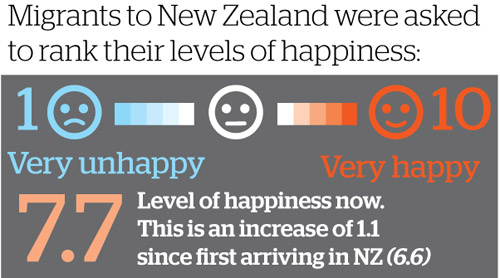
Filipinos are the happiest lot of migrants in New Zealand, ahead of South Koreans and people from the United Kingdom, a survey has found.
The survey by market research company Cultural Connections quizzed more than 600 migrants asking "How happy were you when you first arrived in New Zealand?" and "How happy are you now?"
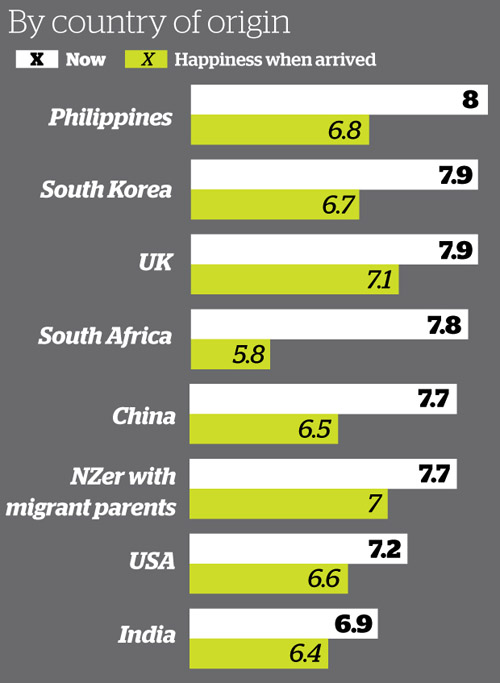
Migrants from the Philippines rated their happiness levels at 8 out of a possible 10, up from 6.8 when they first arrived.
They are followed by South Koreans which went up from 6.7 to 7.9 and the British from 7.1 to 7.9.
The least happy migrants are those from India on 6.9, which is behind the Americans on 7.2.
The survey also found that the longer migrants stay, the happier they are.
Massey University sociologist Paul Spoonley said the findings echoed other research on the topic.
"But the unhappy immigrants might have already left, so we have those who have stayed the distance," Spoonley said.
Older migrants also appear to be happier, with those in their 80s on a happiness level of 9, compared with 7.3 for those in their 40s.

Julia Tolentino moved here 11 years ago with her family and says she is "doubly happy" given the survey shows she is from the happiest ethnic community in NZ as well as the happiest electorate in Auckland. Photo / Dean Purcell
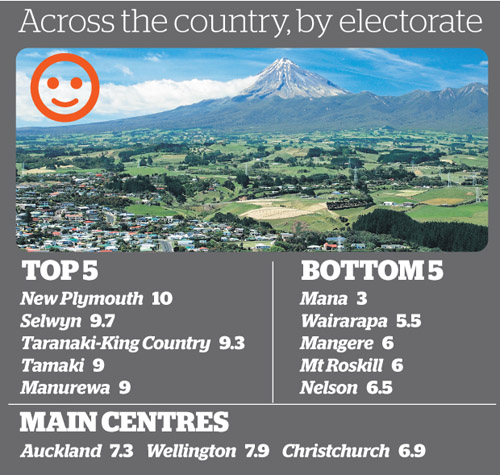
The happiest electorates in New Zealand are New Plymouth, Selwyn and Taranaki-King Country, with Manurewa being the happiest electorate in Auckland.
Mangere and Mt Roskill were the unhappiest in Auckland, and Mana the electorate that's least happy in New Zealand with a score of just 3.
Researcher Eric Chuah said almost half of the respondents from the US were on work visas.
"For the US work visa holders, happiness level was 6.8 when first arrived, but dropped to 6.2," Chuah said.
"This suggest a gap between level of expectation, being told by friends or promised how amazing New Zealand is, versus reality and finding out it is not as amazing."
He said the current presidential mood in America might have also contributed to unhappiness and worrying about family and friends back home.
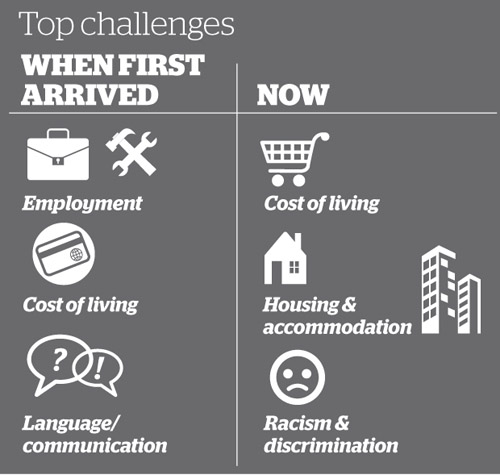
Chuah said most Filipinos migrated to New Zealand in search of better employment.
"They are happier because for the same amount of hours put in a day, Filipinos here are earning more than seven times compared to their home country," he said.
In contrast, Chuah said, most Indians came here on the promise of better education.
"The promise of better education is not living up to expectations," Chuah added.
"The stories of Indian students having to work while studying to repay loans back home and other factors are well known.
'Doubly happy' to be here
Julia Tolentino moved from the Philippines to New Zealand with her family 11 years ago, and lives in Manurewa.
The 22-year-old University of Auckland admin assistant gave a score of 10 in the happiness survey.
"I actually don't have anything to compare my life with, but I just feel absolutely happy living in New Zealand," Tolentino said.
"I feel there's total freedom, and I've got lots of opportunity to do everything that I want to do, there's just nothing to be unhappy about."
She is currently pursuing a post graduate degree in employment relations.
"Manurewa is just a wonderful place to live in, I live just behind Totara Park and there's always people exercising, walking their dogs, it's just a picture of happiness," Tolentino said.
"Coming from the happiest ethnic community and living in the happiest electorate according to the survey, I get you can say I'm doubly happy to be here."
(Source: Lincoln Tan NZ Herald)
09/05/17 - NZ's population boom to fuel economy, even as tourism and construction slows: ASB
Booming tourist numbers have underpinned New Zealand's economic growth, but economists say visitor growth is likely to slow.
Booming population growth will keep economy growing for the next two years, despite a slowdown in key industries, new forecasts predict.
ASB's latest forecasts show the New Zealand economy expanding by 3 per cent in 2017, accelerating to 3.5 per cent in 2018.
The rosy outlook comes despite warnings about two of the main drivers of recent growth - tourism and construction.
"The surge in visitors to New Zealand over the past few years is increasingly stretching accommodation capacity and, while that's spurring more hotel investment, it will take some time to catch up," ASB chief economist Nick Tuffley said.
"Overall construction growth will also slow, and mainly be reduced to areas such as Auckland and Wellington, which will continue to struggle to build fast enough to meet population growth demands."
ASB has also warned that its forecasts could be undermined by global shocks, pointing to North Korea and Syria as "diplomatic powder kegs".
But Tuffley said behind the "noise" the outlook for global growth was reasonable.
"The Trump-led swing to trade protectionism has not been as bad as feared."
Other banks have warned that New Zealand's economic growth is poised to ease, with BNZ predicting on Friday that the growth phase appeared to be "peaking".
"This is manifesting in capacity constraints and slowing productivity," BNZ senior economist Craig Ebert said.
"As this plays out, inflation is firming up, which will, in time, force a reluctant [Reserve Bank] to lift its cash rate."
BNZ forecasts that growth will slow to 2.7 per cent this year and to 2.5 per cent in 2018.
Reserve Bank 'to signal rising rates'
Earlier this year the Reserve Bank signalled that it could leave the benchmark official cash rate (OCR) at the current record low rate of 1.75 per cent until at least the end of 2019, hinting that it believed there was an even chance the next move could be down.
Since then inflation has risen much more quickly than expected, climbing above 2 per cent for the first time since 2011.
The New Zealand dollar has fallen below where the Reserve Bank expected it would and on Friday, the bank's survey of inflation expectations jumped sharply.
The survey showed inflation is expected to be 2.17 per cent in two years, up from expectations of 1.92 per cent three months ago.
While the survey, coupled with figures showing stronger than expected jobs growth at the start of the year, came too late to be included in the Reserve Bank's latest forecasts, governor Graeme Wheeler is expected to give a stronger indication that the OCR will rise, in time.
Westpac's acting chief economist Michael Gordon said that there was little pressure to raise interest rates soon, as while inflation had picked it was likely to hold at around 2 per cent for up to the next two years.
"Nevertheless, the Reserve Bank will have to acknowledge how conditions have changed in the last three months," Gordon said.
"We expect the Reserve Bank's latest interest rate projections to be consistent with an OCR hike by late 2018."
(Source: Stuff)
01/05/17 - Changes in Work Visa and SMC
Newspapers reported in recent months that the number of people arriving in New Zealand on long term and permanent basis is continuing to grow, setting net migration at a new record high.
As a reaction to this, the New Zealand Immigration Minister has introduced new regulations for work visa and residence (SMC) applications. The aim of the new regulations is to improve net migration (in other words reduce the numbers). We believe however that the new instructions are just unworkable. Why?
The proposed new regulations;
- Two salary bands are to be introduced in the Skilled Migrant category permanent and temporary visas.
- The bands are approximate $48,859 (average NZ income) and $73,299 per annum (average New Zealand times 1.5 )
- Applicants in the first band still need to meet ANZSCO, applicants in the second band are automatically deemed to be skilled.
There are proposed limits on the duration of work visas for people in lower income roles (below $48,859 p.a.) of three years followed by a stand down period.
Low-skilled employees would need to go back to their country of origin. An employee in this band may have become very valuable to his or her employer during these three years. He or she may have married, he or she may now have children, or may have purchased a home.
What is more important, he or she may be regarded settled in New Zealand, learned all the rules and regulations, made a circle of friends and has become a member of the New Zealand community. According to the proposed regulations, this person would have to leave the country?
Read more about new regulations here:
Immigration New Zealand is currently in consultation with industry partners regarding these proposed changes, which will come into effect from 15 of August 2017.
Have you say and write in a few lines what your believe to be right or wrong and send to: This email address is being protected from spambots. You need JavaScript enabled to view it.
Covid 19 Notice
As the impact of the coronavirus continues to evolve, we face this unprecedented situation together. The pandemic is affecting all of us. At Terra Nova Consultancy Ltd we wish to reach out and update you on how we are addressing it. Our top priority is to protect the health and safety of our employees, clients, and our communities. Our focus on customer service remains at the center of everything we do, and we are fully committed to continue to serve you with our services, and striving to provide our services without interruption.Please listen and act upon the advise given by the Government, only in that way will we together be able to combat this challenge. And as always, stay healthy and keep safe.
TNC E-books
The Terra Nova e-book page contains publications in e-book and e-news format containing comments and reviews from Terra Nova Consultancy Ltd, and other contributors, that relate to a number of issues from immigration to operating a business.
Some of the Terra Nova e-books e-book and the Terra Nova e-news issues we believe may be quite helpful for prospective immigrants.
Check back regularly to find new editions of our Terra Nova e-book and Terra Nova e-news range.
Quick Links
Translate this site
Contact Details
Terra Nova Consultancy Ltd
165A Old Railway Road
Kumeu
New Zealand
Please arrange visit by appointment.
Mobile: +64 275 706 540
Postal Address:
as above
Licensed Immigration Adviser
Johannes Petrus (Peter) Hubertus Cornelis Hendrikx

License number: 200800214
Is your Immigration Adviser
licenced by the NZ Government?
Click here for details www.iaa.govt.nz